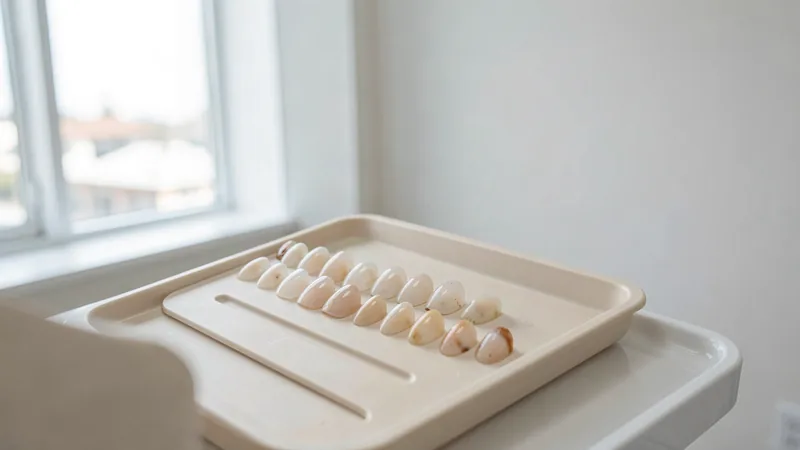
Thinking about a smile makeover? Before you book a consultation, get straight answers to the questions patients ask most — built on real national benchmarks for 2025–2026, honest clinical lifespans, and what insurance actually covers. Here are the first 25.
Cost & Insurance
 Nationally, porcelain veneers run $900 to $2,500 per tooth, with a mean baseline around $1,765 per tooth. Because veneers are elective, standard dental insurance provides zero coverage — plan on self-funding or financing this one.
The short version
- Porcelain veneers run $900 to $2,500 per tooth with a mean baseline around $1,765, and because they are elective, standard dental insurance provides zero coverage.
- The per-tooth trap is the biggest budgeting mistake: eight veneers at the $1,765 mean is $14,120, while a typical six-to-eight-veneer smile makeover is benchmarked at roughly $15,500 as a packaged case.
- Elective procedures are excluded from coverage, but hybrid work that repairs decay or fractures is typically covered at 50 to 80%, and medically necessary treatment can be paid with pre-tax HSA or FSA dollars.
- The three makeover tiers are Enhancement at $600 to $5,000 in 1 to 2 visits, Cosmetic Transformations at $5,000 to $20,000 over 2 weeks to 6 months, and Full Smile Redesigns at $20,000 to $60,000 or more.
- Real veneers remove 0.3 to 0.5 mm of enamel, about the thickness of a contact lens, while a full crown requires circumferential reduction of 60% to 75% of the tooth's structure.
- Digital Smile Design combines intraoral 3D scanning at $20 to $50 micron accuracy with facial analysis of midlines, smile arc, and incisor proportions, and DSD workflows are associated with a 58% improvement in patient satisfaction.
2. Why is a per-tooth recommendation misleading?
The "per-tooth trap" is the biggest budgeting mistake patients make: eight veneers at the $1,765 national mean adds up to $14,120, and CareCredit data benchmarks a typical 6-to-8 veneer smile makeover at roughly $15,500. Always ask for whole-smile pricing instead of per-tooth math — and remember that a recommendation in Cedar Rapids, Iowa can run above or below national averages.
3. Will my insurance cover any cosmetic work?
Purely elective procedures — whitening, cosmetic veneers, gum reshaping for looks alone — are excluded from standard dental insurance. But "hybrid" procedures that also serve a restorative need (crowns, bonding, or onlays that repair decay or fractures) are typically covered at 50% to 80% up to your annual maximum.
4. Can I use HSA or FSA dollars for treatment?
Yes — when treatment is medically necessary (structural tooth loss, vertical dimension collapse, or TMJ pain), pre-tax HSA/FSA funds can pay for it, effectively cutting your real cost by up to 30% depending on your tax bracket. Submit a written pre-authorization with radiographs and photos to lock in the restorative classification before treatment starts.
5. What are the three smile makeover tiers?
Enhancement makeovers ($600–$5,000) pair whitening with bonding and contouring, done in 1–2 visits. Cosmetic Transformations ($5,000–$20,000) place 6–10 porcelain veneers or crowns, sometimes with aligners, over 2 weeks to 6 months. Full Smile Redesigns ($20,000–$60,000+) add implants, grafting, and sinus lifts over 3–12+ months.
6. What do implants and All-on-4 cost?
A complete single implant runs $2,000 to $6,000 (mean $4,500), with about 50% coverage under implant-supported crown codes. All-on-4 full-arch reconstruction runs $15,000 to $30,000+ per arch (mean $24,000), subject to bridge and denture base coverage limits.
Veneers & Materials
7. Porcelain or composite veneers — which should I choose?
Porcelain (lithium disilicate/e.max) runs $900–$2,500 per tooth and lasts $10–$20+ years; direct composite veneers run $250–$1,500 per tooth but last only 5–7 years before staining, wear, or chipping demands replacement. Porcelain is the premium, stain-resistant choice; composite is the budget entry point.
8. What is a prepless ultra-thin veneer?
These featherweight shells ($1,200–$3,000 per tooth, mean $2,100) require no enamel reduction at all, making the procedure non-invasive. With proper care they match traditional veneers' lifespan of $10–$20+ years, and they're the go-to for purely aesthetic enhancement.
9. How much tooth is removed for veneers vs. crowns?
Real veneers remove only 0.3mm to 0.5mm of enamel — about the thickness of a contact lens. Full crowns, by contrast, require circumferential reduction of 60% to 75% of the tooth's structure. That difference is why enamel preservation drives so many treatment decisions.
10. What is lithium disilicate (e.max)?
It's a high-translucency ceramic that mimics the light-reflecting properties of natural enamel, resists staining, and is the go-to material for the visible smile zone. It's used for premium veneers, crowns, inlays, and onlays — and it flexes with natural tooth structure instead of rigidly capping it.
11. How long do porcelain veneers actually last?
Longitudinal survival data shows veneers lasting $10–$20+ years, with documented survival rates exceeding 91% at 20 years. With a night guard if you grind and consistent hygiene, your upfront investment becomes a genuine multi-decade one.
12. Which is cheaper over 20 years: porcelain or composite?
Porcelain wins the long game. Ten porcelain veneers at $1,765 each cost $17,650 upfront and hold near that figure over 20 years (about $18,500 total). Ten composite veneers start at $8,000 but need roughly three replacement cycles in 20 years, pushing the total to $24,000–$33,500.
Procedures
13. What is composite dental bonding?
Bonding sculpts tooth-colored resin directly onto teeth to fix minor chips, small gaps (diastemas), and localized wear. It costs $150–$600 per tooth (mean 430), lasts 3–10 years, and — unlike veneers — may be 50–80% covered by insurance when it's restoring active decay or cracks.
14. What does professional whitening cost?
In-office whitening runs $300–$800 per session (mean 600); take-home professional kits run $100–$400 per kit. Both are elective with zero insurance coverage, and results typically last 1–3 years before relapse — budget for touch-ups to hold the shade.
15. What are inlays and onlays?
Think of them as the "Goldilocks" between fillings and crowns: lab-crafted indirect restorations that fit like puzzle pieces. Inlays fit inside the grooves between the cusps; onlays cover one or more cusps. They cost $700–$1,700 (inlay) or $750–$1,900 (onlay) and last $10–$30 years.
16. Crowns or biomimetic inlays/onlays?
Traditional crowns shave away 60–75% of tooth structure and hide margins below the gum line; biomimetic inlays/onlays remove only 10–30% and sit supragingivally (0.5mm above the gum line), preventing plaque buildup. Conservative adhesive protocols cut the need for root canals by 90–95% — versus the 10–25% of crowned teeth that eventually need one.
17. What is cosmetic gum contouring?
Laser or surgical sculpting of the gumline fixes "gummy" smiles and uneven gingival display. It costs $100–$600 per tooth (mean 350), the result is permanent, and it's generally zero-covered unless medically necessary.
18. Is Botox used in cosmetic dentistry?
Yes — therapeutic/aesthetic Botox runs $300–$600 per target area (mean 450) for gummy-smile mitigation, bruxism, and TMJ pain. Effects last 3–6 months, and insurance may cover it when it's treating documented TMJ pain or grinding rather than aesthetics alone.
Aligners & Implants
19. How much do clear aligners cost?
Invisalign-style treatment runs $3,000–$8,500 per case (mean $5,100). The result is considered permanent only with retention — you'll wear retainers to hold the alignment. Cosmetic orthodontic coverage is rare, though some plans contribute.
20. How long do dental implants last?
Implants carry a $20–$30+ year (essentially lifetime) track record and restore 100% of chewing force. Your side of the deal: meticulous home care and periodic professional recall to prevent peri-implantitis, the main long-term threat to an implant.
21. What is All-on-4?
It's a full-arch reconstruction anchored on four implants — often combined with bone grafting or sinus lifts — that rebuilds an entire arch of teeth for $15,000–$30,000+. Expected lifespan is 20+ years, making it the Tier 3 solution for missing teeth, advanced bone loss, or a collapsed bite.
Digital Smile Design
22. What is a "trial smile" or test-drive smile?
Before any enamel is touched, your dentist places a temporary bis-acryl resin matrix over your unprepared teeth so you can wear, speak, and evaluate the new look in natural light — including phonetics and bite. It converts a leap of faith into a preview you can approve or reject.
23. What is Digital Smile Design (DSD)?
DSD combines intraoral 3D scanning ($20–$50 micron accuracy), photorealistic moving simulations, and facial analysis — midlines, a smile arc parallel to the lower lip, gingival symmetry, and central-incisor proportions — to engineer the smile before treatment begins. DSD workflows are associated with a 58% improvement in patient satisfaction.
24. Digital or traditional workflow — does it matter?
Traditional workflows rely on goopy putty impressions, manual wax-ups, and long lab transit times. Digital workflows scan in minutes, fabricate with micron-level CAD/CAM precision, and typically expose you to less radiation — and a dentist who shows you the design before drilling is a strong green flag.
Maintenance & Long-Term Value
25. How do I protect my smile makeover investment?
Bruxers need a night guard. Implant patients need hygiene recall to stop peri-implantitis. Whitening needs touch-ups every 1–3 years, and composite veneers need replacement every 5–7 years. Porcelain, by contrast, is a $10–$20+ year investment with 91% survival at 20 years — which is exactly why it remains the benchmark choice.