Bone is not a fixed block that teeth sit inside. It is a load-bearing tissue that stays dense where it is asked to work and thins where it is not. That single biological rule explains why a jaw under a denture shrinks, why it happens fast in the first year, and why the fix — four posts carrying load into the ridge — is structural rather than cosmetic. If you have been weighing up cosmetic dental treatment for a home around Cedar Rapids, IA, this guide covers how it actually works, what it tends to cost, and where the results usually fall short.
Bone responds to load, not to presence
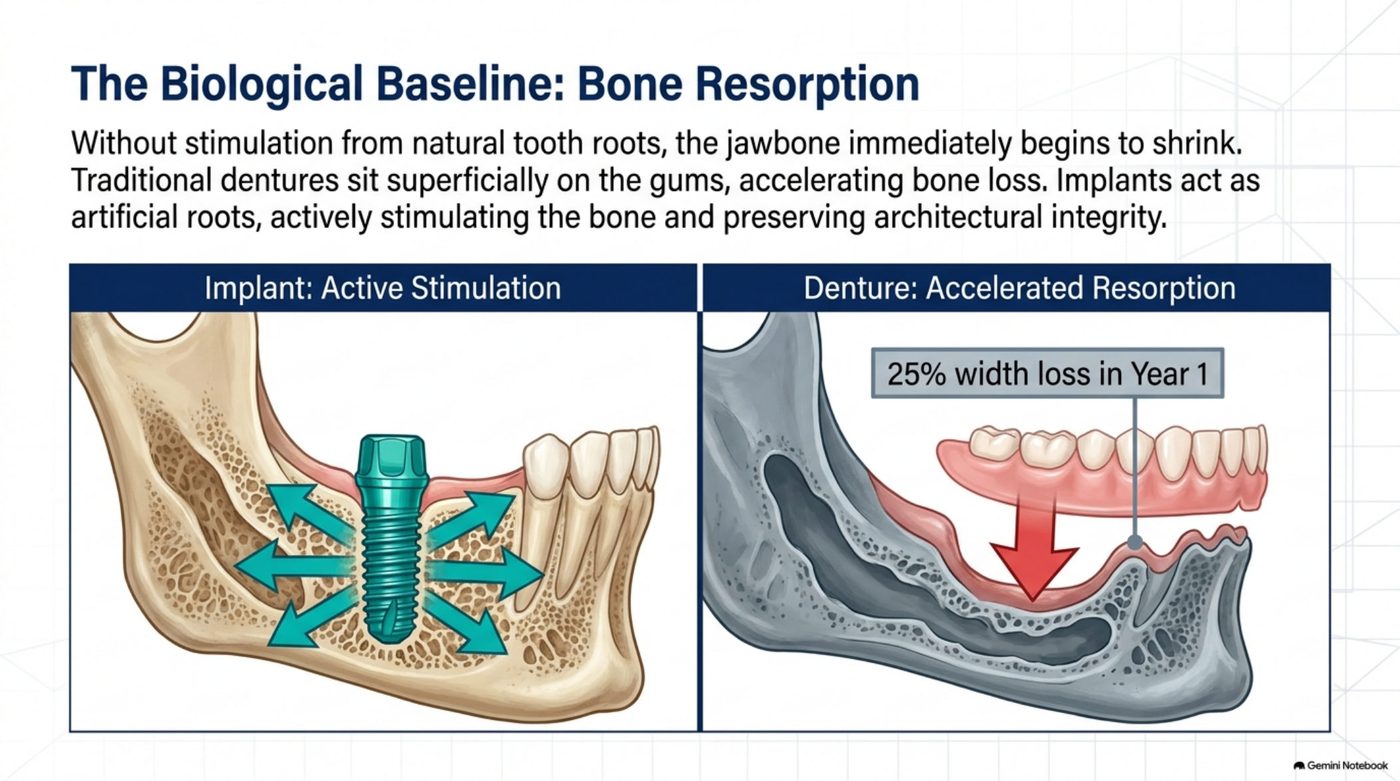
The deck's biological baseline is stated plainly: without stimulation from natural tooth roots, the jawbone immediately begins to shrink. When a tooth root is present, chewing force travels down the root and into the surrounding bone, and the ridge maintains itself in response. When the root is gone, the load path is gone with it, and the ridge has no mechanical reason to stay thick. An implant replaces that lost load path with a titanium post; a denture does not replace it at all.
The short version
- Bone is not a fixed block teeth sit inside but a load-bearing tissue that stays dense where it is asked to work and thins where it is not, which is why a jaw under a denture shrinks.
- Without stimulation from natural tooth roots, about 25% of jawbone width is lost in the first 12 months, a first-year measurement of direction and speed rather than a fixed annual rate.
- A denture sits superficially on the gums and spreads chewing force across gum tissue and the ridge crest, so the ridge receives pressure where it needs load, and the matrix scores it as accelerating loss.
- All-on-4 scores as active stimulation because the four titanium posts function as artificial roots, carrying load from the fixed bridge into the bone around them and preserving the ridge's architectural integrity.
- The two angled posterior posts maximize contact with the bone that remains in the posterior jaw, a geometry the deck describes as completely bypassing the need for bone grafting or sinus lifts.
- Across 25 years, denture relines every 1 to 3 years and replacements every 5 to 7 years are all delivered to a shrinking ridge, against a 25+ year All-on-4 base structure with posts that are not replaced.
The year-one number: about 25% of ridge width
The deck anchors the measurement at year one: approximately 25% of jawbone width is lost in the first 12 months without root stimulation. That is a quarter of the ridge in a single year, and it happens before most patients have settled into a maintenance routine. The figure is a first-year measurement rather than an annual rate — what it establishes is direction and speed, not a yearly invoice. It is also the number that reframes the whole conversation. A patient comparing a denture quote against an implant quote is not comparing two appliances; they are comparing two trajectories for the same bone.
| Bone-relevant outcome | Under traditional dentures | Under All-on-4 implants |
|---|---|---|
| Jawbone preservation | No — accelerates loss | Yes — active stimulation |
| Ridge width, first 12 months | About 25% of width lost without root stimulation | Chewing load carried into bone through four posts |
| Where chewing force goes | Into gum tissue across the saddle | Down the posts and into the ridge |
| Bite strength restored | 20–30% | 90%+ |
| Base-structure lifespan | 5–8 years | 25+ years (lifetime posts) |
| Replacement cadence | Relines every 1–3 yrs; full replacement every 5–7 yrs | Crown replacement every 10–15 yrs |
Why a denture accelerates rather than buffers the loss
Traditional dentures sit superficially on the gums. They spread chewing force across gum tissue and the crest of the ridge instead of transmitting it into bone, and the ridge receives pressure where it needs load. The matrix scores jawbone preservation for dentures as no — accelerates loss. Two mechanisms run at once. The bone is unloaded, so it thins; the soft tissue and the ridge crest are compressed, so the surface the denture sits on deforms as the support beneath it recedes. Every reline is a fix aimed at the symptom. The denture is being re-fitted to a foundation that is moving.
What active stimulation actually preserves
All-on-4 scores yes — active stimulation for one reason: the four titanium posts function as artificial roots. Load from the fixed bridge travels through the posts into the bone around them, which is the same mechanical signal natural roots provided. That is what the matrix means by preserving architectural integrity — not merely filling the space where teeth were, but keeping the ridge structurally intact so the arch has something stable to sit on. It is also why the two angled posterior posts matter so much in areas where the ridge has already thinned: angling maximizes contact with the bone that remains, completely bypassing the need for bone grafting or sinus lifts.
The compounding cost of a shrinking foundation
Bone loss is not a one-time adjustment, it is a maintenance multiplier. Because a denture base structure is rated for 5–8 years, needs relines every 1–3 years, and is fully replaced every 5–7 years, every one of those interventions is delivered to a ridge that is smaller than it was at the last appointment. Across 25 years that is four to five full replacements and between eight and twenty-five relines for the same arch. Each appointment is charged against a foundation that has degraded since the last one. The implant side runs the opposite arithmetic, because the bone being loaded is bone being kept: the base structure is rated 25+ years, the titanium posts are permanent, and only the prosthetic crowns on top move on a 10–15 year cadence.
The function cost of a shrinking ridge
Bone loss is not only a fitting problem. Dentures restore 20–30% of natural bite force; as the ridge under them changes, the appliance that depends on suction and contact has less to hold. All-on-4 restores 90%+ of natural bite force because the load runs through posts anchored in bone, not through a saddle balanced on gum tissue. In practical terms, the same patient can be eating a different diet on each of these two paths, and the difference tracks the ridge as much as the restoration.
Measuring your own trajectory
Before committing to any full-arch plan, ask what the ridge looks like now and what it is projected to look like at the end of the first year, the fifth, and the tenth. The deck's numbers give you the framework to read the answer — roughly 25% of width gone in year one without stimulation, relines every 1–3 years, full replacement every 5–7 years on the denture path, and 25+ years of loaded stability on the All-on-4 path. The full analysis sits in the companion deck at The Structural Restoration Guide (PDF); the budget side of the same decision is covered in the cost benchmarks, the smile makeover cost guide, and the calculator hub, and you can pressure-test your own priorities with the smile quiz.
Frequently asked questions
Does the 25% first-year figure keep repeating every year?
The deck's number is specifically a first-year measurement of roughly 25% ridge width lost without root stimulation. It is not presented as a fixed annual rate, and no honest projection should treat it as one. What the figure does establish is that the first year carries the largest single loss in that timeline, which is why the window for acting on bone is at the front of the process rather than the back.
Can a denture be made to fit a ridge that is already shrinking?
It can be refitted, which is exactly what a reline is — and the matrix schedules relines every 1–3 years precisely because the ridge keeps changing. The limit is that a 5–8 year base structure cannot outrun a foundation it sits on top of; each reline restores contact without restoring bone.
Does placing implants always mean grafting?
Not in the All-on-4 design. Two anterior posts go where bone density is naturally highest, and the two posterior posts are angled to maximize contact with the bone that remains in the posterior jaw — a geometry the deck describes as completely bypassing the need for bone grafting or sinus lifts. Where bone is already severely deteriorated, that has to be confirmed on imaging case by case.