Almost nobody pays for a full-arch restoration in a single transfer. The practical question is not whether the total is affordable as one payment, but how to sequence the available funding sources so the number you actually pay shrinks. There are four, they stack in a specific order, and the order matters more than the negotiation. If you are here looking into full smile makeover, the sections below walk through the process from the first quote to the finished job.
Used correctly, the combination of insurance, pre-tax dollars, and installment credit converts a five-figure procedure into a defined monthly figure — and, on the tax-advantaged portion, into a genuine discount rather than a deferral.
The short version
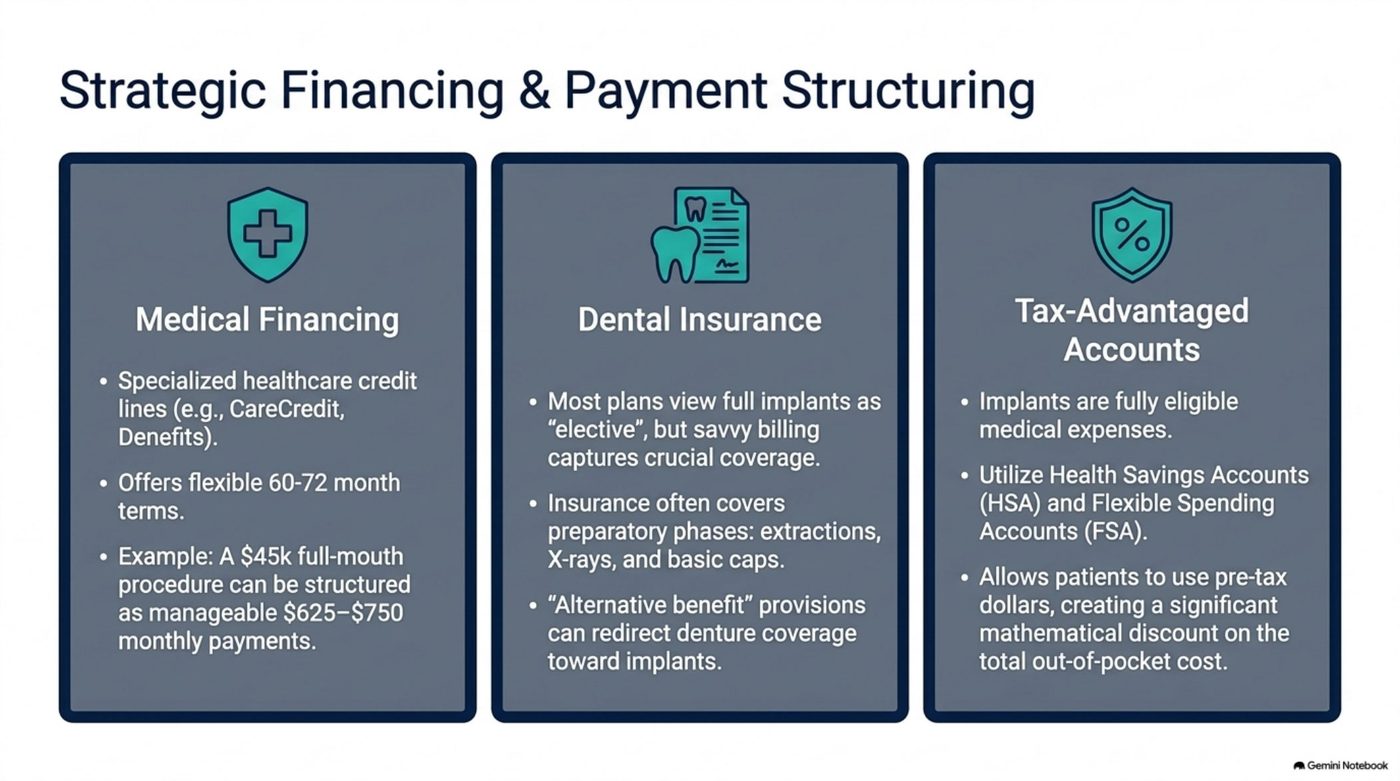
- Four funding sources stack in a specific order: dental insurance first and per benefit year, then HSA or FSA dollars, then a medical credit line such as CareCredit or Denefits applied to the residual balance.
- A $45,000 full-mouth procedure spread across 60 to 72 months becomes $625 to $750 per month, which is why the monthly figure rather than the sticker price is the number worth comparing.
- Dental implants qualify in full as eligible medical expenses, so pre-tax HSA or FSA dollars reduce the effective cost by roughly 25% to 35% — about $11,000 to $16,000 on a $45,000 case.
- Most plans classify full implants as elective and exclude them, but coverage can be captured through preparatory extractions and diagnostic X-rays, basic restorative work, and documented medical necessity filed as a written pre-authorization with radiographs and photographs.
- An alternative benefit provision can redirect the amount a plan would have paid toward a denture into the implant restoration instead, and it is routinely left unused because nobody asks for it in writing at pre-authorization.
- Unused insurance is the largest avoidable cost: on a case with eight extractions at $150 to $400 per tooth, timing the work across a year boundary shifts $1,200 to $3,200 onto a second annual maximum.
The four funding sources and what each does
| Source | What it covers | Terms and mechanics | When to apply it |
|---|---|---|---|
| Dental insurance | Preparatory phases: extractions, X-rays, basic caps | Annual maximums; typically 50–80% of covered items | First, and per benefit year |
| HSA / FSA | Eligible medical expenses — implants qualify in full | Pre-tax dollars; roughly 25–35% effective discount by bracket | Before any taxable credit |
| Medical credit line (e.g. CareCredit, Denefits) | The residual balance after the first two sources | Flexible 60–72 month terms | Last, applied to what remains |
| “Alternative benefit” provision | Redirects existing denture coverage toward implants | Plan-specific; must be confirmed in writing | At pre-authorization |
The monthly payment math on a medical credit line
Specialized healthcare credit lines are built for exactly this kind of procedure. The deck's example: a $45,000 full-mouth procedure spread across 60 to 72 months becomes $625 to $750 per month. That is the whole point of the instrument — it converts a lump sum into a budget line, and it is why the monthly figure, not the sticker price, is the number worth comparing against alternatives.
HSA and FSA: the only source that is a discount, not a deferral
Implants are fully eligible as medical expenses, which makes Health Savings Account and Flexible Spending Account dollars unusually valuable here. Paying with pre-tax dollars reduces the effective cost by roughly 25% to 35% depending on your bracket — on a $45,000 procedure, that is on the order of $11,000 to $16,000 of real, permanent savings rather than a payment schedule. Two constraints shape the strategy: FSA balances generally do not roll over, so they should be deployed within the plan year, while HSA balances accumulate and can be spent years after they are earned, which makes them the better vehicle for staging a multi-phase case.
The insurance reality: elective by default, covered by documentation
Most plans classify full implants as “elective” and therefore excluded, which is where most patients stop. That classification is a default, not a verdict. Savvy billing captures coverage by documenting the restorative necessity behind the preparatory work instead of the cosmetic outcome. Three areas typically qualify:
- Preparatory phases: extractions and diagnostic X-rays, which are covered services in their own right regardless of what follows.
- Basic caps: interim and basic restorative work performed while the case is planned.
- Documented medical necessity: a written pre-authorization with radiographs and photographs, filed before treatment begins, settling the elective-versus-restorative question in advance rather than after the bill arrives.
Alternative benefit provisions
Some plans include an alternative benefit provision: if a plan would have paid a set amount toward a denture, that amount can be redirected toward the implant restoration instead. It does not cover the whole procedure, but it is money already sitting in the plan, and it is routinely left unused because nobody asks. Request the provision in writing at pre-authorization so the credit is applied before the case starts rather than argued about afterward.
Staging across benefit years
The single largest avoidable cost in a full-arch case is unused insurance. Annual maximums reset, and preparatory work — extractions, X-rays, basic restorative — can often be timed so two benefit years absorb two maximums instead of one. On a case with eight extractions at $150–$400 per tooth, splitting the work across a year boundary can shift $1,200–$3,200 of spending onto a second maximum.
| Step | Action | What it changes |
|---|---|---|
| 1 | File written pre-authorization with radiographs and photographs | Settles elective vs. restorative before treatment starts |
| 2 | Time extractions and basic work across two benefit years | Captures two annual maximums instead of one |
| 3 | Fund the balance with HSA or FSA dollars | 25–35% effective discount on that portion |
| 4 | Close the residual with a 60–72 month credit line | $625–$750 per month on a $45,000 procedure |
Run in that order, the four sources are not additive in cost the way they appear to be. The discount comes first, the deferral comes last, and the financed balance is the smallest number in the sequence.
The order that saves the most
- File insurance first, per benefit year. Extractions and basic work can be spread across two benefit years to capture two annual maximums.
- Deploy pre-tax dollars next. HSA or FSA money is the cheapest capital available and should cover as much of the remaining balance as the account allows.
- Close the residual with a medical credit line. Financing only what is left keeps the monthly payment as low as the terms allow.
What financing is not
Stretching payments does not reduce the price; it reshapes it. A 72-month term lowers the monthly figure, not the total. The tax-advantaged dollars are the only part of the sequence that changes what you actually pay, which is why deploying HSA or FSA money before any taxable credit is the highest-value move available and the one most often skipped.
Run your own figures with the smile makeover cost guide, the veneer cost calculator, and the rest of the calculator suite. The financing and insurance detail behind this article is in The Smile Architecture Blueprint.
Frequently Asked Questions
Does using a medical credit line hurt my credit?
Applying for any credit line involves a hard inquiry, and the account then behaves like other revolving or installment credit. The relevant variable is utilization: a $45,000 balance on a line sized for it, paid down on schedule over 60–72 months, carries a very different profile from a balance that sits near the limit.
Can I use HSA funds for a procedure my insurance calls elective?
Yes. HSA eligibility follows the tax code's definition of a qualified medical expense, not the insurance plan's coverage decision. Dental implants qualify. The plan's “elective” label affects what insurance pays, not what your HSA can reimburse.
What single step most reduces the total I pay?
Written pre-authorization before treatment starts. It settles coverage, captures the alternative benefit provision, and prevents the cosmetic-versus-restorative classification from being decided after the work is already complete — when your ability to dispute it is gone.