All-on-4 is often described as four implants and a bridge. That description is accurate and useless. The treatment works because of where the four posts go, which direction two of them point, and what the bridge does once it is anchored. Read as geometry, the design answers three separate problems at once: where bone is strong, where bone is missing, and how to carry a full arch on four contact points instead of eight or ten. If you have been weighing up cosmetic dental treatment for a home around Cedar Rapids, IA, this guide covers how it actually works, what it tends to cost, and where the results usually fall short.
The anterior posts: two straight implants where bone density is highest
Two of the four titanium posts are placed perfectly straight and vertically in the anterior jaw, the region where bone density is naturally highest. This is the load-bearing core of the design. Straight, vertical placement puts the post directly under the force it will receive, so chewing load travels down the axis of the implant rather than bending it. It also sites the two most important posts in the part of the ridge least likely to have deteriorated, which is why the design can be delivered to patients whose posterior ridges would fail a conventional implant assessment.
The short version
- All-on-4 works because of where the four posts go, which direction two of them point, and what the bridge does once anchored, answering three problems at once about bone strength, bone gaps, and arch support.
- Two posts are placed perfectly straight and vertical in the anterior jaw where bone density is naturally highest, so chewing load travels down the implant axis rather than bending it.
- Two posterior posts are angled intentionally to maximize contact with the bone that remains, which completely bypasses the need for bone grafting or sinus lifts and removes that entire surgical phase with its healing time and cost.
- The angled placement also spreads four anchor points across the arch rather than clustering them at the front, allowing a full-arch bridge to be supported without placing a post in every tooth position.
- The arch itself is a single fixed bridge that stays in place for brushing and water-flossing around the abutments, with crown replacement every 10 to 15 years and permanent titanium posts treated as lifetime components.
- The geometry restores 90% or more of natural bite force against 20 to 30% for a denture, and the load path through the posts is the same mechanism that provides active bone stimulation rather than pressure.
The posterior posts: two angled implants that skip grafting
The other two posts are placed in the posterior jaw, and they are angled intentionally. Angling maximizes contact with the bone that actually remains back there — and by reaching usable bone at an angle, it completely bypasses the need for bone grafting or sinus lifts. That single mechanical decision removes an entire surgical phase, with its own healing time and its own cost line, from the treatment. It also spreads the four anchor points across the arch rather than clustering them at the front, which is what allows a full-arch bridge to be supported without placing a post in every tooth position.
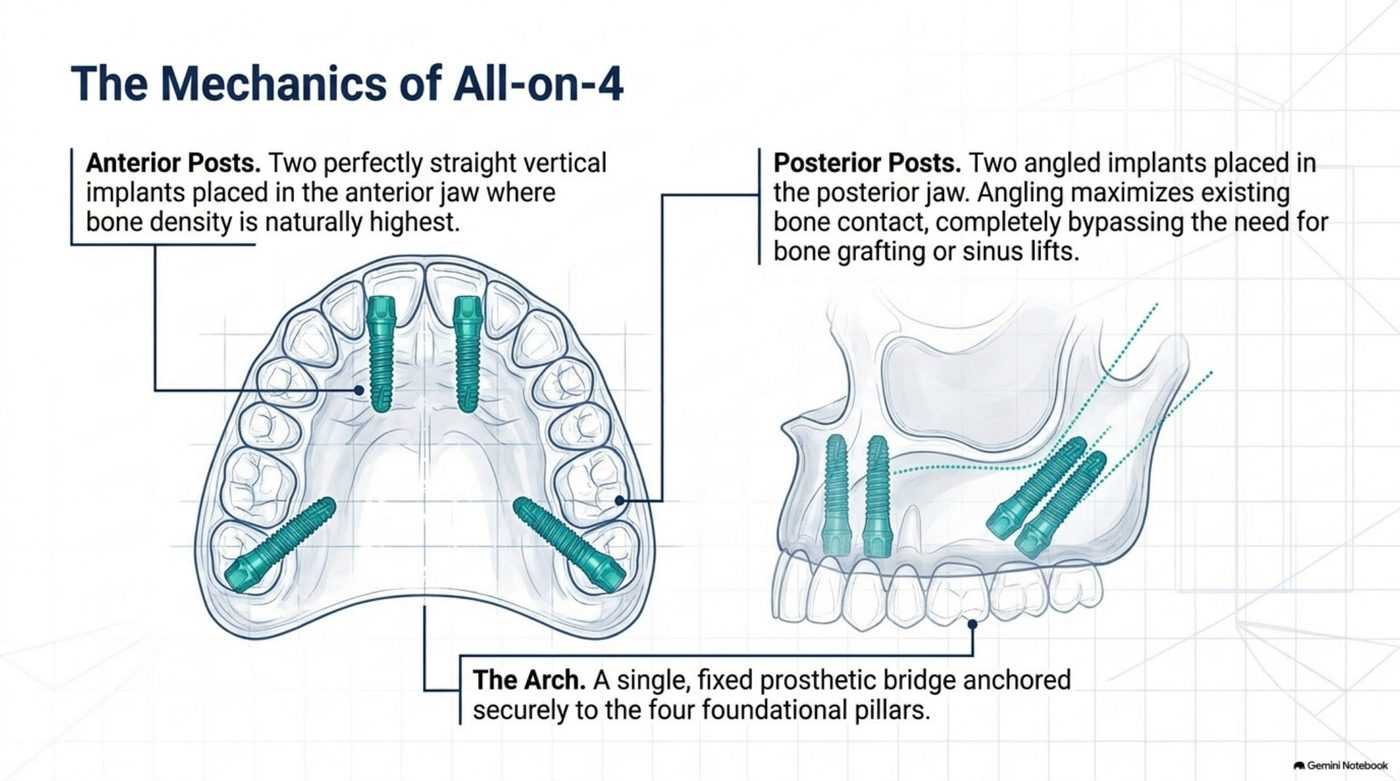
| Design element | What it is | What it accomplishes |
|---|---|---|
| Anterior posts (2) | Straight vertical implants in the anterior jaw | Sited where bone density is naturally highest; chewing load runs straight down the implant axis |
| Posterior posts (2) | Angled implants in the posterior jaw | Maximize contact with existing bone; completely bypass bone grafting and sinus lifts |
| The arch | One fixed prosthetic bridge anchored to four pillars | Stays in place for brushing and water-flossing; crown replacement every 10–15 yrs, posts lifetime |
| Resulting bite force | 90%+ of natural function restored | Versus 20–30% for a denture sitting on the gums |
The arch: one fixed prosthetic bridge on four pillars
The third element is a single fixed prosthetic bridge anchored securely to the four foundational pillars. Fixed is the operative word. The arch does not come out, does not soak, and does not depend on adhesives for retention — it is cleaned in place, brushing and water-flossing around the abutments like a natural arch. Because the foundation is four posts rather than a ridge-wide contact surface, the prosthetic can be replaced on its own schedule: crown replacement on the arch falls at 10–15 years, while the permanent titanium posts are treated as lifetime components and are not scheduled for replacement at all.
Why the geometry delivers 90%+ bite force
Dentures restore 20–30% of natural bite force because they transfer chewing load into gum tissue across a saddle. The All-on-4 geometry does the opposite: load enters the bridge, travels down four posts with straight anterior axes and angled posterior contacts, and is delivered into bone. The result is 90%+ of natural bite force restored. That number is not a comfort statistic, it is a load-path statistic — and it is the same load path that keeps the bone around the posts alive.
The bone consequence of the same design
Because the posts act as artificial roots, the ridge under an All-on-4 arch receives stimulation instead of pressure. The matrix scores All-on-4 jawbone preservation as yes, active stimulation, against no, accelerates loss for dentures, and the underlying number is the one to keep in view: roughly 25% of jawbone width is lost in the first year without root stimulation. The anterior posts sit in the densest bone and the posterior posts are angled to reach whatever dense bone remains, so the design is deliberately built around preserving the ridge it depends on. Base-structure lifespan follows: 25+ years for All-on-4 versus 5–8 years for a denture base.
What the four-post design asks of you
Two maintenance obligations come attached. The first is daily: a fixed arch is brushed and water-flossed around the abutments, because the bone around the posts is protected by hygiene, not by materials. The second is professional, on a regular recall schedule, so the prosthetic and the posts can be inspected before small problems become structural ones. Neither obligation is heavy; both are non-negotiable, and they are the true cost of keeping a four-post arch functioning at 90%+ bite force for the next 25 years.
Where the mechanics sit in the larger plan
The geometry explains the structure; the deck's companion guide, The Structural Restoration Guide (PDF), carries the full 25-year cost-benefit analysis that sits on top of it, including the replacement cadence of relines every 1–3 years and full replacements every 5–7 years on the denture path. If the decision you are weighing is financial rather than mechanical, start with the cost benchmarks or the smile makeover cost guide. To compare the prosthetic materials that can be carried on these four posts, use the tools hub, and to sanity-check your own priorities before a consultation, the smile quiz takes a few minutes.
Frequently asked questions
Why angle the posterior posts instead of placing them vertically?
Because vertical placement in the posterior jaw is exactly where bone is often missing — the region that would otherwise require bone grafting or a sinus lift to build up. Angling the two posterior posts maximizes contact with the existing bone, which removes that surgical phase entirely while still giving the bridge four well-separated anchor points.
Why only four posts for a full arch?
Two straight anterior posts sit in the region of naturally highest bone density, two angled posterior posts reach usable bone further back, and the four together carry one fixed bridge. Fewer posts means less surgical exposure and no need for a post under every tooth position, while the bite-force result still lands at 90%+ of natural function versus 20–30% for a denture.
What has to be replaced over time?
The prosthetic above the posts, not the posts themselves. Crown replacement on the arch runs on a 10–15 year cadence, while the permanent titanium posts are not scheduled for replacement — the base structure is rated 25+ years. Compare that to a denture base rated 5–8 years with relines every 1–3 years and a full replacement every 5–7 years.