When Cedar Rapids patients ask whether veneers are "worth it," the honest answer lives in the data — specifically, in a decade of clinical trials tracking how thin ceramic laminates actually survive in real mouths. The headline is surprisingly clear: the most conservative option is also the most durable.
The survival gap
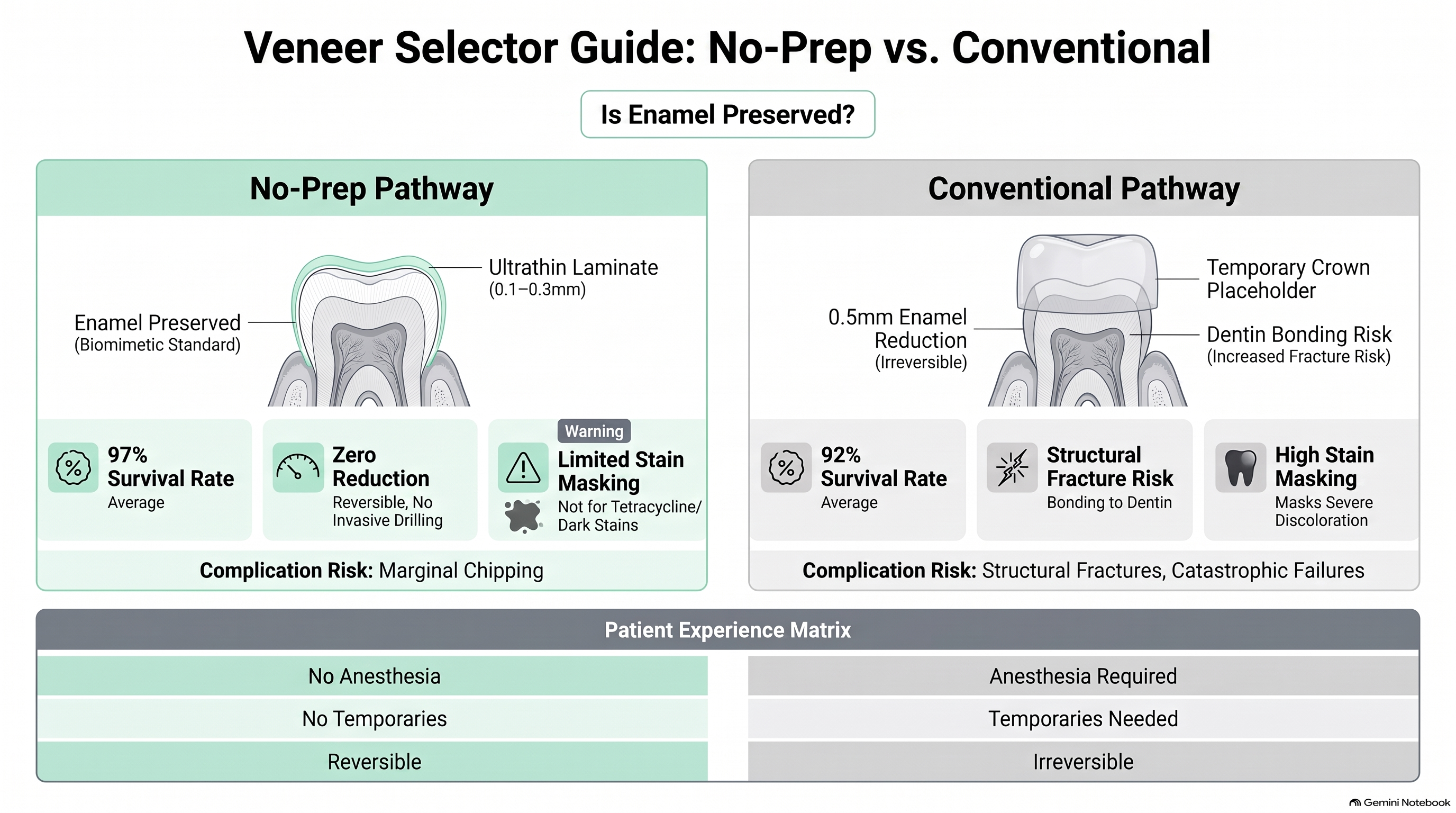
Across long-term trials that followed patients for up to nine years, no-prep veneers hold a mean survival rate of about 97%, compared to roughly 92% for conventional veneers. Overall survival for both approaches ranges from 91% to 100% — so veneers in general are a durable investment — but the no-prep approach consistently lands at the top of that range.
Why the gap? The answer is chemistry. No-prep veneers bond directly to enamel, the hardest substance in the body. Enamel's rigidity distributes bite forces evenly, keeping the adhesive interface stable and resisting the micro-cracks that eventually doom a restoration. Conventional veneers require reducing the enamel — about 0.5 mm — to make room for the laminate, which moves the bond toward the softer, more flexible dentin beneath.
The failure modes tell the real story
Durability is only half the picture; how a restoration fails matters just as much. No-prep veneers fail in minor, reversible ways — marginal chipping or debonding, where the laminate detaches intact and the tooth underneath is untouched. Conventional veneers, by contrast, carry higher-risk failure modes: porcelain fractures, tooth fractures, and endodontic (nerve) damage that can require a root canal or crown.
In other words, when a no-prep veneer has a problem, it's a quick chairside fix. When a conventional veneer has a problem, it can escalate into major restorative work. That asymmetry is the strongest argument for choosing the most conservative treatment that your case allows.
What this means for your decision
None of this means conventional veneers are a bad choice — for patients with severe discoloration, deeper damage, or specific cosmetic goals, they may be the right answer. But if your enamel is healthy and your concerns are cosmetic, the data says you can achieve a dramatic result while sacrificing zero healthy tooth structure.
The right move is to ask your dentist the two questions the data rewards: "How much enamel will be removed?" and "What does your survival data show for this approach?" A dentist who answers both comfortably is the one you want. In Cedar Rapids, our matching service connects you with pre-qualified cosmetic dentists who can walk you through your specific case — free, with no obligation.