Implant placement starts two repair clocks on completely different scales. Soft tissue moves on a timeline you can see in a mirror — days and weeks. Bone fusion moves on a timeline you can only measure on a radiograph — months. Most people in Cedar Rapids feel normal and pain-free by week 3 while the bone-to-titanium interface is still months short of maximum structural integrity, and that quiet gap is where nearly all avoidable implant failures begin. If you are here looking into cosmetic dental treatment, the sections below walk through the process from the first quote to the finished job.
The two clocks of healing
The fast clock is superficial tissue. Bleeding from the surgical site normally stops within 24 to 48 hours of steady, light gauze pressure. Mucosal closure around the implant is typically complete in 7 to 14 days, dissolvable sutures are gone by roughly day 10 to 14, and swelling — which peaks at day 3 — is largely resolved by day 7. The slow clock is osseointegration. Bone cells deposit directly onto the titanium surface, and the interface reaches maximum structural integrity over a 3- to 6-month window, with the outer boundary quoted at 6 months.
The short version
- Implant placement starts two repair clocks on different scales: soft tissue closes in days to weeks while bone fusion takes months, so most people feel pain-free by week 3 while the interface is still months from maximum integrity.
- Osseointegration reaches maximum structural integrity over a 3-to-6 month window, and at week 3 the bone-to-titanium interface is typically only about 40 to 55% complete, which makes week 3 a comfort milestone rather than a mechanical clearance.
- Bone reliably grows onto titanium only when movement at the interface stays below roughly 50 to 100 microns, so a single bite of an apple or crust of bread at month 2 can generate loads far above that threshold.
- Early overload rarely fails immediately, showing up later as a soft radiographic margin and first-year bone loss of 0.5 mm or more, after which removal means re-grafting, a second surgical site, and another 3-to-6 month fusion window.
- Timeline gates are measured rather than felt: insertion torque around 35 Ncm or higher, implant stability quotient readings of 65 to 70 or higher, bone density, smoking (which roughly doubles failure risk), and an HbA1c above about 7%.
- Failing at month 3 roughly costs a second reconstruction at $15,000 to $30,000 per arch at 2025 to 2026 benchmarks, plus another half year without teeth and another round of surgical healing.
That mismatch is the point. At week 3 the mucosa is sealed and inflammation has resolved, but the bone is only partway through the fusion process. Week 3 is a comfort milestone, not a mechanical clearance.
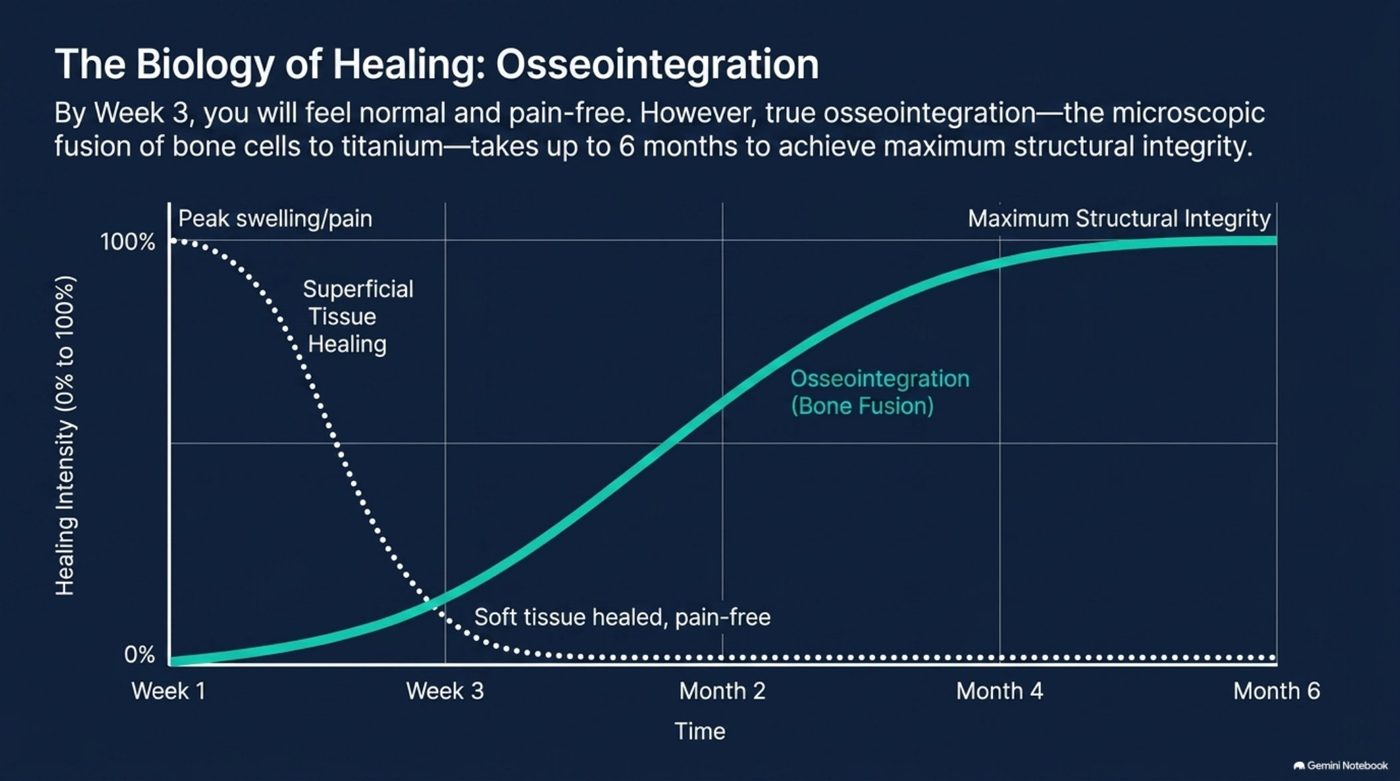
The healing-intensity curve, stage by stage
Plot both processes on one axis — 0% to 100% healing intensity — and the lines separate immediately after the first week. Soft tissue runs to near-complete in about 14 days. Bone fusion climbs steadily and does not flatten out until month 4 to 6. The table below tracks both curves with the clinical milestones attached to each.
| Timepoint | Soft tissue status | Approx. bone-to-titanium integrity | Clinical milestone | Loading status |
|---|---|---|---|---|
| Week 1 | Swelling at peak, sutures in place | 10–25% (clot organizing, initial contact) | Post-op check; inflammation declining | No load on the surgical site |
| Week 3 | Mucosa closed, gums pink, pain-free | 40–55% | Comfort returns; stitches gone | No load; soft diet continues |
| Month 2 | Tissue mature, no visible signs | 60–75% | Full hygiene routine re-established | Provisional only, if clinically cleared |
| Month 3 | Fully healed, contour stable | 70–85% | Earliest common prosthetic decision point | Load testing in selected cases |
| Month 4–6 | Unchanged | 85–100% | Maximum structural integrity | Permanent prosthetic placed |
Percentages are approximate structural integrity and vary with bone density at the site, implant length and diameter, smoking status, and diabetes control. Two patients can feel identical at week 3 and still sit 20 percentage points apart on the fusion curve.
Why the week-3 comfort signal is not a green light
The governing trade-off is micromotion. Bone reliably grows onto a titanium surface when movement at the interface stays below roughly 50 to 100 microns. A single bite of an apple or a crust of bread at month 2 can generate peak loads far above that threshold at the implant site. When that happens, fibrous tissue can form at the interface instead of bone — the implant becomes a mechanically loose peg held by scar, not a fused structural post.
The failure is rarely immediate, which is what makes it dangerous. It shows up later as a soft radiographic margin, first-year bone loss of 0.5 mm or more, and a restoration that eventually has to come out. Removing and replacing a failed implant means re-grafting, a second surgical site, another 3- to 6-month fusion window, and a second prosthetic. That is the most expensive single mistake available in the first four months after surgery — the whole investment paid twice for the same tooth position.
The decision points that actually gate your timeline
Timelines are set by measured thresholds, not by how the patient feels:
- Primary stability: insertion torque around 35 Ncm or higher signals a well-anchored implant; below that, the site is treated as a delayed-loading case.
- Implant stability quotient (ISQ): readings of 65 to 70 or higher support early-loading protocols; readings that dip during healing push the prosthetic date later.
- Bone density: dense posterior mandible fuses faster than soft, low-density maxilla, which commonly adds 4 to 8 weeks.
- Smoking: roughly doubles the relative risk of implant failure and slows mucosal closure by several days.
- Diabetes control: an HbA1c above about 7% measurably delays osseointegration.
- Bruxism: untreated clenching concentrates loads on the prosthetic and shortens the interval you can safely load the interface.
What changes between month 3 and month 6
Two things shift. First, the prosthetic itself: the permanent restoration is placed after 3 to 6 months of successful osseointegration, replacing the provisional. Second, hygiene instrument selection, because from this point you are maintaining a titanium surface rather than watching a surgical wound. Professional cleanings move to specialized non-scratch instruments that will not roughen the titanium and give bacteria a rougher surface to colonize. If you want to vet those protocols before committing to a practice, our periodontal vet checklist walks through exactly what to ask.
The financial case for honoring the calendar
Waiting is the cheapest line item in the entire treatment. The difference between an implant that reaches month 6 unloaded and one that fails at month 3 is approximately a second reconstruction — 15,000 to 30,000 dollars per arch at 2025–2026 national benchmarks — plus another half year without teeth and another round of surgical healing. Nothing you gain by chewing hard food eight weeks early is worth that exposure. The full timeline and cost model is laid out in the Smile Architecture Blueprint (PDF), and the failure modes are covered in our guide to cosmetic dental risks.
FAQ About Osseointegration Timing
Can I get my permanent teeth sooner than six months?
Sometimes, but only inside a measured protocol. Early and immediate loading is reserved for cases with insertion torque at or above roughly 35 Ncm, ISQ readings of 65 to 70 or higher, good bone density, and no smoking or uncontrolled diabetes. Even then, the prosthetic is designed and tightened to control micromotion, not simply placed earlier. Most patients sit at 70–85% fusion at month 3, which is why the standard prosthetic window stays at 3 to 6 months rather than 3 weeks.
Does feeling normal at week 3 mean the implant is fully fused?
No. Week 3 tells you the mucosa has closed and inflammation has resolved. It says nothing about the bone interface, which is typically only 40–55% of the way to maximum structural integrity at that point. Comfort is a wound-healing signal; fusion is a biomechanical one. The two are frequently confused, and that confusion is the leading cause of early overload.
What happens if I chew hard food at month 2?
Movement above roughly 50 to 100 microns at the interface can replace bone formation with fibrous tissue. The implant may feel fine for months and then show as a soft margin on an X-ray with bone loss exceeding 0.5 mm in the first year. At that stage the options narrow to surgical intervention or removal — and removal means re-grafting and a fresh fusion cycle.
The practical rule for the whole 6-month window is simple: treat week 3 as permission to stop worrying about pain, and treat month 6 as permission to bite normally.