If you've ever had a crown or bridge recommended, you've probably heard the word "zirconia" — and for good reason. Zirconia is the gold standard for permanent dental restorations, prized for structural strength, durability, and wear resistance that outlasts older materials. What's changed recently is how fast and precisely it can now be made.
Why zirconia earns the gold standard
Zirconia's advantage is mechanical. It withstands the heavy, repeated forces of biting and chewing without the chipping and wear that plague resin-based materials. For crowns, bridges, and implant restorations — where a restoration must survive decades of daily stress — zirconia is simply the strongest, most reliable ceramic available.
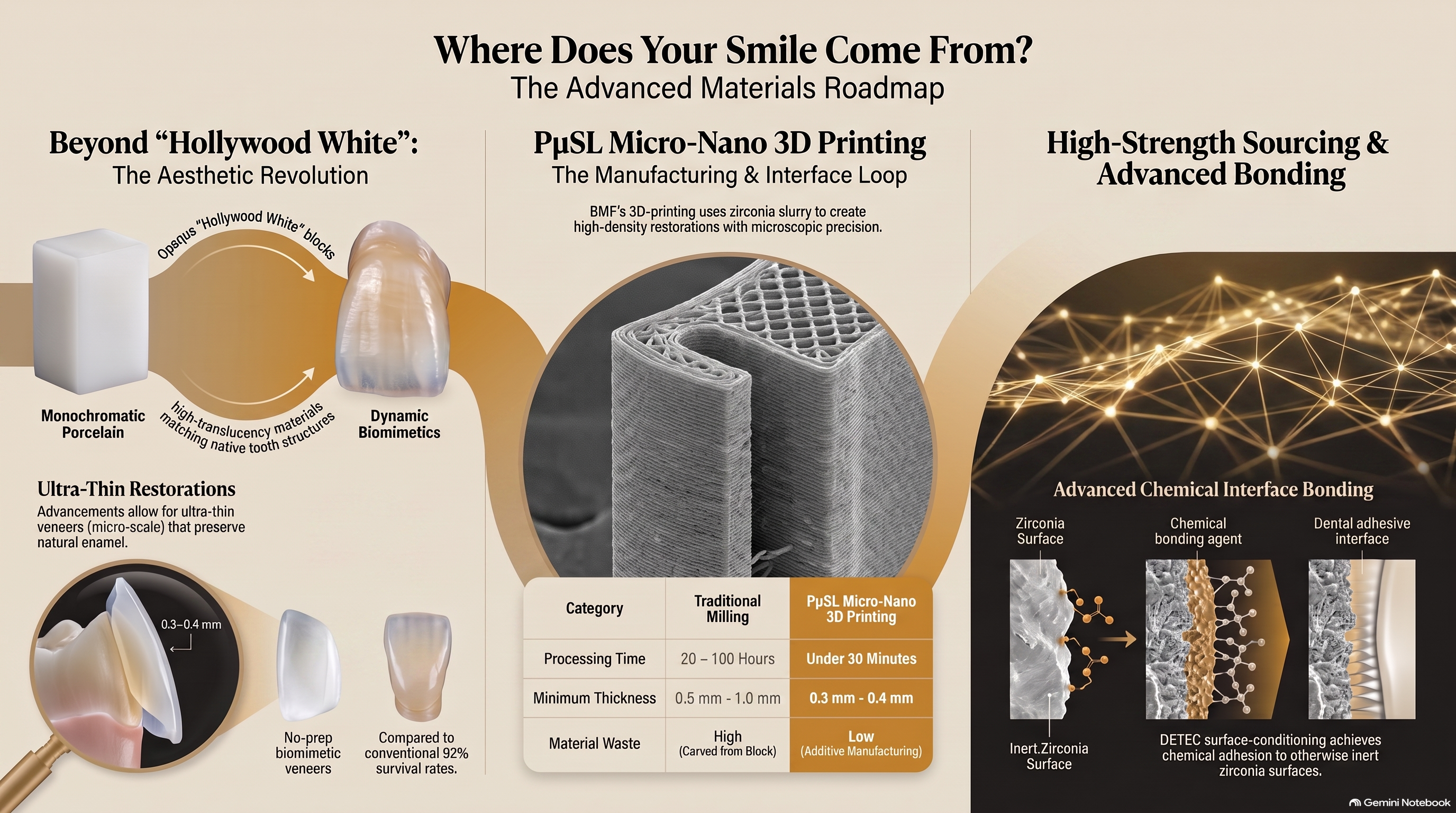
Historically, zirconia had one serious weakness: it's chemically inert, which made it nearly impossible to bond with traditional adhesives. That changed with advanced surface-conditioning techniques that create a powerful, durable chemical bond — and, crucially, allow zirconia to mask dark or discolored teeth underneath.
The 3D-printing bottleneck
For years, zirconia restorations were milled from a solid block — a process that works but wastes material, limits design complexity, and risks introducing microscopic cracks. 3D printing promised a better path, but it hit a wall: zirconia must be "debinded" by burning off polymer binders, and trying to speed that step up made the binders gasify too quickly. The trapped gas cracked the restoration.
The breakthrough came from the University of Texas at Dallas. By surrounding the restoration with porous graphite felt — which withstands temperatures above 2,550°F and lets released gases escape — and pairing it with a vacuum system, researchers cut the debinding stage to under 30 minutes. That made same-day, 3D-printed zirconia a clinical reality.
What 3D-printed zirconia means for you
The clinical benefits are concrete: sub-millimeter customization, tighter marginal fits, faster treatment times, and a permanent high-strength restoration in a single visit. And when a raw-material supply shock hit global zirconia powder (Japan's Tosoh froze supply over yttrium-oxide export prices), manufacturers like Aidite responded by validating localized alternatives — so ultra-thin zirconia kept flowing and now represents a growing share of modern milling centers.
For a Cedar Rapids patient, the takeaway is simple: the material that used to mean a multi-week wait and a temporary crown can increasingly be delivered same-day, without sacrificing any of the strength that made zirconia the standard in the first place.