An All-on-4 restoration carries two separate price tags. The first pays for the surgical foundation — four titanium posts placed in the jaw. The second pays for the prosthetic arch that anchors onto those posts, and that is the half most patients never audit. Material choice is the single largest variable in the prosthetic half: an acrylic-composite arch and a milled zirconia arch can be attached to the exact same four implants, on the exact same day, at meaningfully different cost and meaningfully different longevity. Most people who read this are comparing cosmetic dental treatment options around Cedar Rapids, IA, so what follows sticks to the details that change in practice.
A typical clinical quote for one arch lands between $24,000 and $32,000, with a national range of $15,000 to $40,000 depending on region and zirconia grade. Knowing which end of that band applies to you requires knowing what the arch is made of — and what happens to it across the next two decades.
The short version
- An All-on-4 restoration carries two separate price tags — the surgical foundation of four titanium posts and the prosthetic arch — and material choice is the single largest variable in the prosthetic half.
- A typical clinical quote for one arch lands between $24,000 and $32,000, with a national range of $15,000 to $40,000 depending on region and zirconia grade.
- The fixed arch absorbs the entire bite load, restoring roughly 90% of natural bite force once healed against 20 to 30% for a conventional denture, which makes durability a structural rather than cosmetic question.
- Acrylic is cheaper upfront but flexible, prone to chipping and staining, and needs crown-level replacement every 10 to 15 years, while milled zirconia is rigid, resists chipping and staining, and is built around a 25-year horizon.
- Zirconia costs more because it cannot be fabricated casually, requiring a scanned master model, a digital design pass, a milling and sintering cycle, and control of shrinkage during sintering.
- Acrylic's genuine advantages are comfort during healing and chairside repairability, since a chipped section can be bonded back the same day while a zirconia fracture means a laboratory remake.
What the prosthetic arch actually does
The arch is a single fixed bridge spanning the full curve of the jaw, anchored to the four implant posts through custom abutments. It replaces the visible teeth and the chewing surface at the same time, which means it absorbs the entire bite load: roughly 90% of natural bite force once healed, against 20–30% for a conventional denture. Everything the arch does, it does under load, every day, for years. Durability is therefore not a cosmetic detail — it is a structural one.
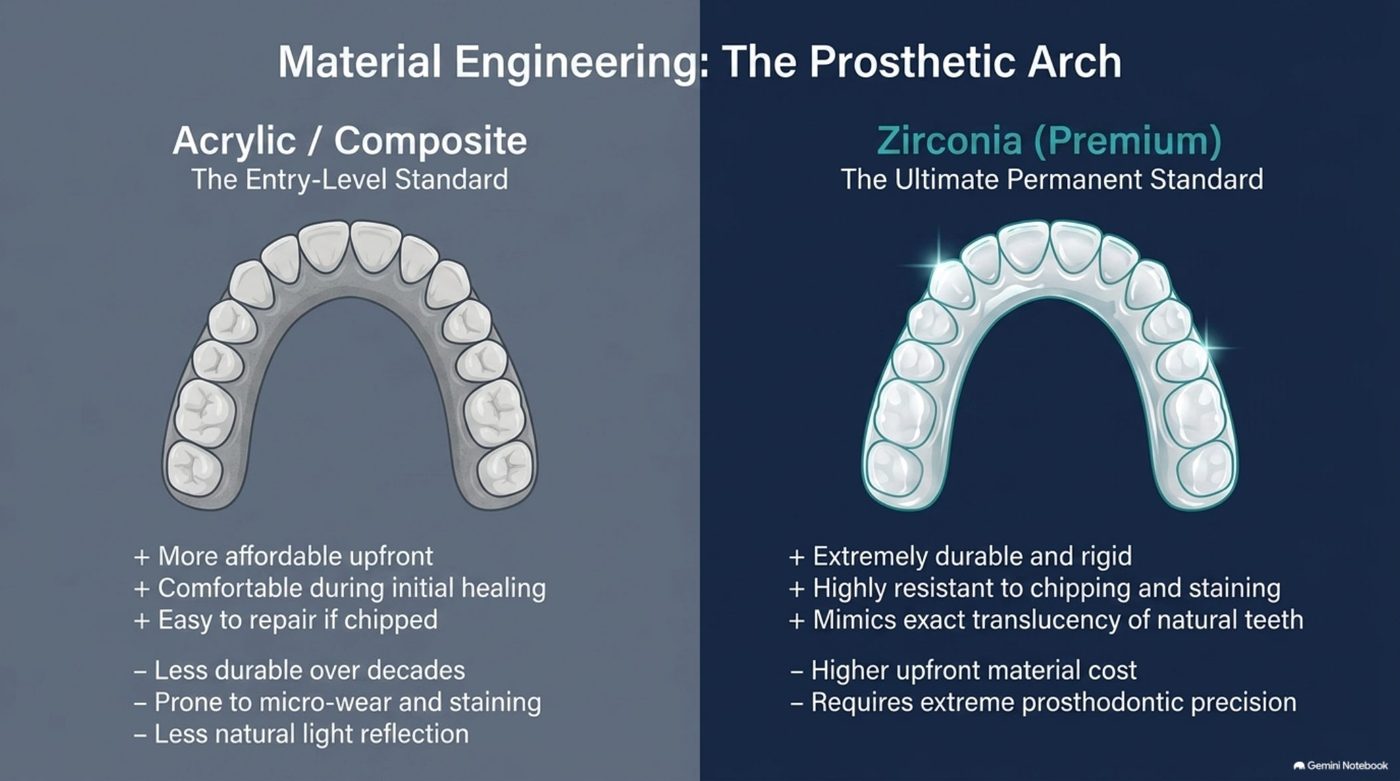
Acrylic/composite vs. zirconia, side by side
| Property | Acrylic / composite arch | Zirconia (premium) arch |
|---|---|---|
| Upfront material cost | Lower — sits at the bottom of the clinical band | Higher — pushes toward the top of the band, up to $40,000 in high-cost regions |
| Rigidity | Flexible; absorbs impact energy | Extremely rigid and dimensionally stable |
| Chip resistance | Prone to chipping, but repairable | Highly resistant to chipping |
| Staining | Prone to micro-wear and staining over years | Highly resistant to staining |
| Light behavior | Less natural light reflection | Mimics the exact translucency of natural teeth |
| Repair pathway | Chairside repair; composite can be bonded back | Requires a laboratory remake |
| Comfort during healing | Comfortable during the initial healing phase | Rigid contact from day one |
| Fabrication demand | Moderate | Extreme prosthodontic precision required |
| Service life | Shorter across decades; crown-level replacement every 10–15 years | Built around the 25-year horizon |
Where the cost difference actually comes from
A zirconia arch is not expensive because the material is exotic. It is expensive because it cannot be fabricated casually. Milling a full-arch zirconia prosthesis to fit four implant posts within microns requires a scanned master model, a digital design pass, a milling and sintering cycle, and control of shrinkage during sintering so the final fit is accurate. Acrylic-composite arches are processed in a conventional dental laboratory, adjusted chairside, and seated with a lower precision demand. That difference in production complexity — not the raw material — is what separates the low and high ends of the $15,000–$40,000 national band.
Wear, staining, and the light question
Acrylic and composite are softer polymers. Under years of chewing they accumulate micro-wear on the occlusal surface, and the polymer matrix absorbs pigment from coffee, tea, red wine, and turmeric. The result is slow change in both dimension and color. Zirconia resists both: it does not absorb pigment, and it holds its shape under load. The trade-off is optical. Zirconia is more opaque than natural enamel, and an arch milled from a single monolithic block reflects light less like a natural tooth. Skilled prosthodontic layering closes most of that gap, which is precisely why the material demands extreme precision — a zirconia arch produced without that craftsmanship can look less natural than a well-made acrylic one.
The one clinical advantage acrylic genuinely holds
Acrylic is comfortable during the initial healing phase. A softer, slightly flexible interface against freshly placed implant sites and healing soft tissue produces less pressure and fewer sore spots in the first weeks. Acrylic is also repairable: if a section chips while the patient adapts to a new bite, composite can be bonded back in the chair and the patient leaves with a working arch the same day. A zirconia fracture means a laboratory remake and a temporary arch in the interim.
When premium zirconia actually pays
Zirconia is the better economic choice when the patient is likely to hold the arch long enough to need replacement. Three signals point that way:
- Age and horizon. A patient in their 40s or 50s is planning around a 25-year or longer lifespan. Replacing a worn or cracked acrylic arch even once inside that window erases much of the upfront saving.
- Parafunction. Bruxism and heavy clenching load the arch far beyond normal chewing. A rigid material resists that load; a flexible one wears and chips.
- Pigment exposure. Daily coffee, tea, red wine, or tobacco accelerates polymer discoloration that zirconia simply does not experience.
Acrylic stays defensible when upfront budget is the binding constraint, when the healing phase is expected to be difficult, or when the patient wants a path that can be repaired rather than remade. The mistake is treating the two as equivalent because both attach to the same implants. They are not equivalent — they are a trade of upfront dollars against future replacement cycles.
To model both materials against your own budget, use the smile makeover cost guide and the full calculator suite. The complete clinical and financial breakdown behind these figures is in the deck, The Smile Architecture Blueprint.
Frequently Asked Questions
Does the material choice change the implant surgery itself?
No. The four titanium posts, their placement angles, and the custom abutments are determined by bone anatomy, not by the arch material. Acrylic and zirconia attach to the same foundation. What changes is fabrication cost, the precision of the fitting process, and how the arch behaves after years of load.
Can I start with acrylic and upgrade to zirconia later?
Yes, and it is a common staging strategy. The acrylic arch serves through the healing period and the first years of function, and a zirconia arch is fabricated later against the same implant positions once bone stability is confirmed. The staged route costs more in total than choosing zirconia up front, but it spreads the largest single expense across two budget cycles.
How do I know which end of the $15,000–$40,000 range applies to me?
Ask for the quote split into two parts: the surgical line (implants, abutments, imaging) and the prosthetic line (material, laboratory work, temporary arch). The prosthetic line is what moves. A single blended number hides the exact decision you need to make.