The first four weeks after All-on-4 surgery split into three windows with three different sets of rules: days 1–3, days 4–7, and weeks 2–4. Almost everything that goes wrong in the first month is decided in the first 72 hours, and almost everything patients regret later traces back to a rule from one of those windows being broken. If you have been weighing up cosmetic dental treatment for a home around Cedar Rapids, IA, this guide covers how it actually works, what it tends to cost, and where the results usually fall short.
Days 1–3: the inflammatory peak
Mild bleeding, bruising, and swelling are expected, and swelling peaks around day 3 before turning. The protocol is mechanical rather than heroic:
The short version
- The first four weeks split into three windows — days 1 to 3, days 4 to 7, and weeks 2 to 4 — and almost everything that goes wrong in the first month is decided in the first 72 hours.
- Days 1 to 3 call for ice 20 minutes on and 20 minutes off for 48 to 72 hours, plus steady light gauze pressure for 30 to 45 minutes, with pink-tinged saliva normal for 24 to 48 hours.
- Gentle saltwater rinses, about half a teaspoon of salt in 8 ounces of warm water two to three times daily, begin around day 4, and straws stay banned for the full first month because suction pressure disturbs the healing clot.
- The diet targets 60 to 80 grams of protein per day and permits only soft room-temperature foods, with no hard or crunchy chewing at the implant site throughout the month.
- Call the office for a fever above 101.5 degrees Fahrenheit, swelling that increases rather than decreases after day 4, pain uncontrolled by the prescribed schedule 72 hours after surgery, or numbness lasting more than 6 to 12 hours.
- The four weeks sit inside the 3-to-6 month osseointegration window, where bone forms only while interface movement stays below roughly 50 to 100 microns; one broken diet rule can cost a failed implant and a $15,000 to $30,000 reconstruction.
- Ice: 20 minutes on, 20 minutes off, repeated through the day for the first 48 to 72 hours. That is roughly 8 to 12 cycles per day. Cold limits the swelling that peaks on day 3.
- Pain medication: follow the prescribed schedule exactly and stay ahead of the pain rather than chasing it. Patients who wait until pain reaches 6 out of 10 need more medication to reach the same relief as patients who dose on schedule.
- Bleeding: steady light gauze pressure for 30 to 45 minutes. Pink-tinged saliva is normal for 24 to 48 hours. Bright red bleeding that continues after 30 minutes of continuous pressure is not.
- Sleep: keep the head raised 30 to 45 degrees for the first 2 to 3 nights. Lying flat pools fluid in the surgical site and increases morning swelling.
- Hands off: no rinsing, no spitting, no straws on day 1. Suction and pressure can disturb the clot that is forming.
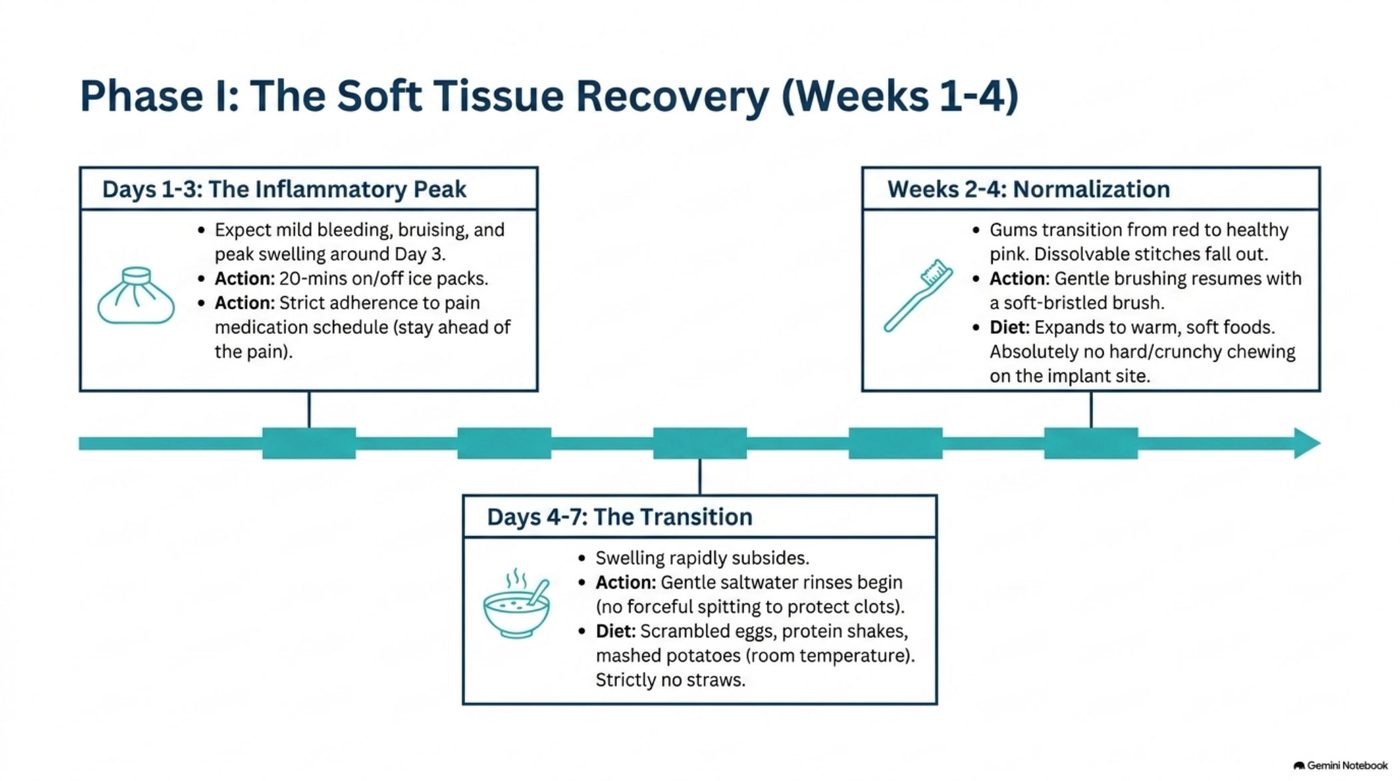
Days 4–7: the transition
Swelling drops quickly once the day-3 peak passes. Bruising, if any, shifts from purple to yellow-green and fades. This is the window where controlled rinsing begins and the diet starts to move:
- Rinses: gentle saltwater rinses — about half a teaspoon of salt in 8 ounces of warm water, 2 to 3 times daily — starting around day 4. No forceful spitting; let the water fall out of your mouth to protect the clot.
- Diet: scrambled eggs, protein shakes, and mashed potatoes at room temperature. Aim for 60 to 80 grams of protein per day, which is the intake range associated with faster wound healing.
- Straws: strictly none. The suction pressure is the problem, and it applies for the full first month, not just the first week.
- Activity: light walking from day 1 is fine and helps circulation. No lifting over about 10 pounds, no bending strain, and no strenuous exercise for 7 days.
Weeks 2–4: normalization
Gums transition from red to healthy pink, and dissolvable stitches fall out on their own, usually between day 7 and day 14. Gentle brushing resumes with a soft-bristled brush — twice daily, 2 minutes each time, light pressure, and no direct scrubbing force over the implant sites in the first days. Diet expands to warm soft foods, and the one bright line stays bright: absolutely no hard or crunchy chewing on the implant site. That restriction is what protects the bone-to-titanium interface while it is still fusing. The four-week diet ladder below keeps the boundaries clear.
| Window | Swelling / sensation | Required action | Diet allowed | Hard no |
|---|---|---|---|---|
| Days 1–3 | Peak swelling day 3; mild bleeding and bruising | 20 min on / 20 min off ice; pain meds on schedule | Cool liquids, lukewarm broth, protein shakes (no straw) | Rinsing, spitting, straws, hot food |
| Days 4–7 | Swelling rapidly subsides; soreness easing | Gentle saltwater rinses 2–3x daily; soft-bristle brushing starts | Room-temperature scrambled eggs, mashed potatoes, shakes | Forceful spitting, straws, crunchy food |
| Weeks 2–4 | Gums pink; stitches gone; minimal discomfort | Soft-bristle brushing 2x/day; brushing along the gumline gently | Warm soft foods: pasta, soft fish, cooked vegetables | Hard/crunchy chewing at the implant site |
| Week 4+ | Normal unless the practice says otherwise | Practice-directed hygiene and recall schedule | Per clinical clearance — often a soft-chew diet for 3 months | Biting hard food directly over the prosthetic until cleared |
Red flags with numbers attached
Contact the office the same day if any of the following appear. Each has a threshold that separates normal healing from a problem worth a phone call:
| Sign | Threshold that warrants a call | Why it matters |
|---|---|---|
| Fever | Above 101.5°F (38.6°C) | Signals infection rather than ordinary post-surgical inflammation |
| Bleeding | Continues after 30 minutes of continuous gauze pressure | Sustained bleeding can indicate a clot problem at the site |
| Swelling | Increasing rather than decreasing after day 4 | Late-rising swelling points to infection or a fluid collection |
| Pain | Not controlled by the prescribed schedule 72 hours after surgery | Uncontrolled pain beyond the expected window needs review |
| Numbness | Persisting more than 6 to 12 hours after the anesthetic should have worn off | Needs prompt assessment of nerve involvement |
| Prosthesis | Rocking, clicking, or a loosened screw at any point | Movement at the interface risks the fusion that is still under way |
Why the calendar is not negotiable
The first four weeks sit inside the osseointegration window, which runs 3 to 6 months. Bone deposition onto the titanium surface proceeds reliably only while movement at the interface stays below roughly 50 to 100 microns. Break the diet rule in week 3 — for example, by chewing a hard roll at the implant site — and the cost of that single meal can run to a failed implant and a second reconstruction at 15,000 to 30,000 dollars per arch. No food is worth that. If you want to know which of your own habits put the timeline most at risk, the smile quiz walks through risk factors in a few minutes, and our cosmetic dental risks guide covers the failure modes in detail. The recovery protocol above tracks the same schedule published in the Smile Architecture Blueprint (PDF).
FAQ About the First Four Weeks
When can I stop using ice?
Stop at 48 to 72 hours, once swelling has clearly peaked and started to fall. Ice limits swelling while it is rising; after the day-3 peak it does less, and continuous use beyond that point can reduce blood flow to tissue that needs circulation for healing.
Can I use a straw after week 2?
No. Suction pressure near a healing site is the reason straws are restricted, and the restriction holds for the full first month. Drink from a cup or glass and take small sips.
Is it normal for the gums to look uneven at week 3?
Yes, within limits. Tissue contour often looks slightly uneven while it matures, and it usually evens out over weeks 3 to 8. Unevenness combined with increasing swelling, discharge, or pain after day 4 is a different situation and should be evaluated the same day.