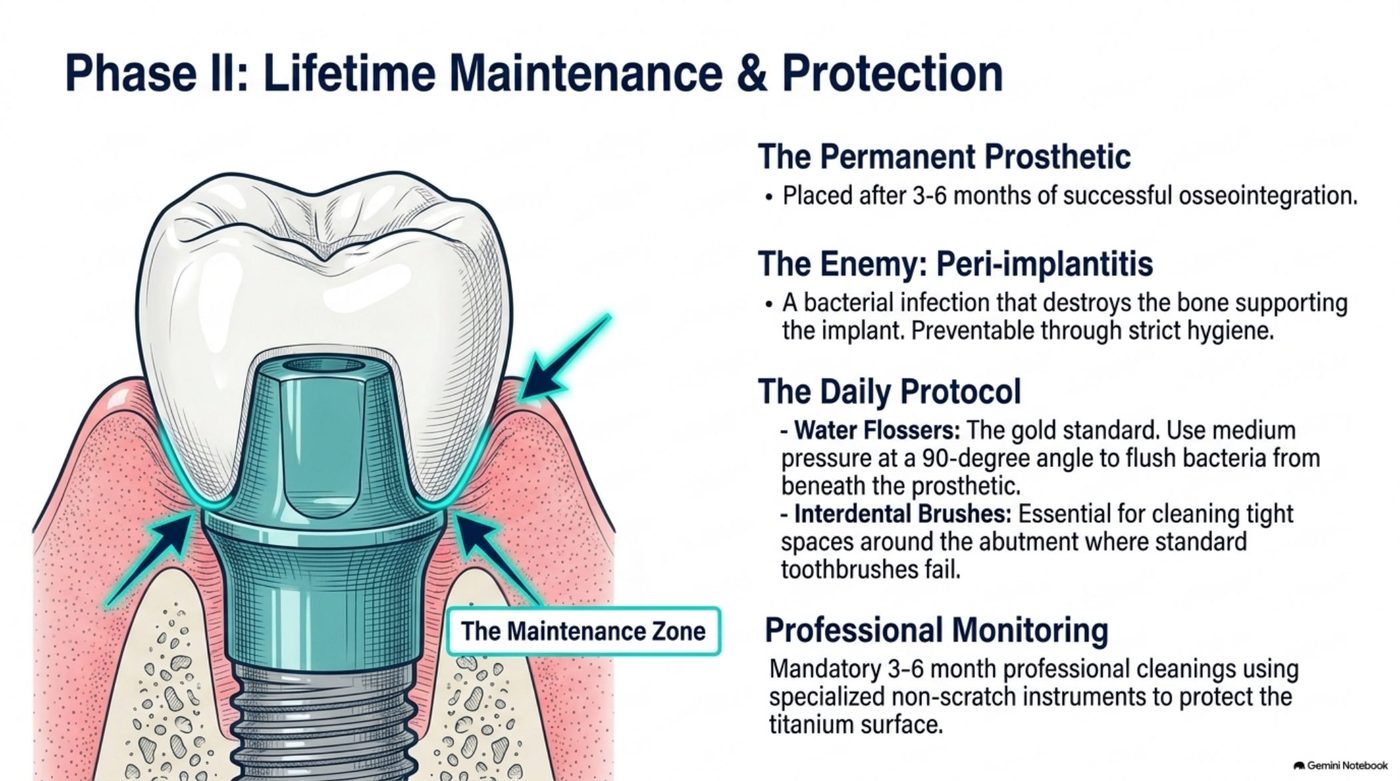
A permanent full-arch prosthetic is placed only after 3 to 6 months of successful osseointegration. From that day forward the clinical question changes completely. It is no longer whether the implant will fuse — that has been settled — but how long the bone supporting it will hold. For most patients, the answer is decided by maintenance habits rather than by the surgery itself. If you have been weighing up cosmetic dental treatment for a home around Cedar Rapids, IA, this guide covers how it actually works, what it tends to cost, and where the results usually fall short.
The enemy has a name: peri-implantitis
Peri-implantitis is a bacterial infection that destroys the bone supporting an implant. It starts the same way gum disease starts around natural teeth: biofilm accumulates at the margin, the surrounding tissue becomes inflamed, and the process spreads below the gumline. The difference is the anatomy. A natural tooth is suspended by a periodontal ligament that acts as a seal and a shock absorber. An implant fuses directly to bone with no ligament barrier, so an infection that reaches the implant margin has a shorter path to the foundation holding everything up.
The short version
- Peri-implantitis is a bacterial infection that destroys the bone supporting an implant, starting like gum disease with biofilm at the margin, and it affects roughly 1 in 5 implants over 9 to 14 years.
- An implant fuses directly to bone with no periodontal ligament seal or shock absorber, so an infection reaching the implant margin has a shorter path to the foundation.
- The daily protocol uses a water flosser twice daily at medium pressure and a 90-degree angle to the gumline for 60 to 90 seconds, plus interdental brushes sized to the 0.6 to 1.2 mm gap around the abutment.
- Because titanium is softer than the stainless-steel curettes used on natural teeth, professional cleanings need non-scratch or non-metal instruments such as titanium, carbon fiber, or plastic tips on a 3-to-6 month schedule.
- Monitoring thresholds are a probing depth of 4 mm or less and stable, any bleeding on probing, and roughly 0.2 mm or less of annual bone loss after the first year, with prosthetic fit checked at every recall.
- Recall cleanings at $150 to $350 per visit, or about $600 to $1,400 a year, compare against $1,500 to $5,000 or more for surgical peri-implantitis treatment and $2,000 to $6,000 per unit for implant replacement.
The early, reversible stage is peri-implant mucositis — inflammation with bleeding but no bone loss. Left alone, it progresses to peri-implantitis and measurable bone destruction. Pooled analyses put mucositis at roughly 2 in 5 implants and peri-implantitis at roughly 1 in 5 over a 9- to 14-year follow-up, which is why maintenance is not optional. The disease is also quiet: many patients feel nothing until the restoration moves or a radiograph shows the damage.
The daily protocol
Home care around an implant-supported prosthetic is more demanding than around natural teeth, not less, because the prosthetic creates spaces that a standard toothbrush cannot reach. Four tools cover the job:
| Tool | Frequency | Specification | What it targets |
|---|---|---|---|
| Water flosser | 2x daily | Medium pressure, 90-degree angle to the gumline, 60–90 seconds, slowly traced along the full margin | Flushes bacteria from beneath the prosthetic — the gold standard for full-arch cases |
| Interdental brushes | 1–2x daily | Sized to the gap around the abutment (roughly 0.6–1.2 mm ISO sizing) | Cleans the tight spaces around the abutment where a standard toothbrush cannot make contact |
| Soft-bristle toothbrush | 2x daily, 2 minutes | Non-abrasive paste, light pressure along the gumline | Removes plaque from broad surfaces without scratching the titanium |
| Antibacterial rinse | Only as directed | Short courses of chlorhexidine 0.12% for acute inflammation | Controls flare-ups; not a substitute for mechanical cleaning |
Two settings matter more than the brand of tool. Water pressure should be medium: too high can injure the mucosal seal, too low leaves biofilm behind. The angle should be 90 degrees to the gumline so the stream sweeps under the prosthetic rather than across it. Interdental brush size matters too — a brush that passes easily but without slack removes plaque; one that is too small does nothing and one that forces the tissue causes bleeding that masks the signal you are trying to read.
Why the instrument used on titanium matters
Titanium is softer than the stainless-steel curettes used on natural teeth. Metal scaling instruments scratch the implant surface, and a roughened surface gives bacteria a better grip — the opposite of the intended effect. Professional cleanings on implants should therefore use non-scratch or non-metal instruments, typically titanium, carbon fiber, or plastic tips. This is a maintenance-zone requirement that runs every 3 to 6 months, and it is one of the fastest ways to tell whether a practice actually maintains implants or merely places them. Our periodontal vet checklist lists the three questions that surface the difference in a single consultation.
The monitoring thresholds
Maintenance works because bone loss is measurable before it is visible. These are the numbers clinicians watch:
- Probing depth: 4 mm or less and stable is the target. A reading of 5 mm or more, especially with bleeding, moves the site into active treatment.
- Bleeding on probing: any bleeding at the implant margin indicates active inflammation and should be resolved before it escalates.
- Annual bone level change: published success criteria allow roughly 0.2 mm or less of bone loss per year after the first year. A trend steeper than that is the earliest hard signal of trouble.
- Prosthetic integrity: screw torque, fit, and occlusal contact are checked at every recall. A rocking prosthetic concentrates load on individual implants.
What maintenance costs versus what failure costs
Professional cleanings every 3 to 6 months run roughly 150 to 350 dollars per visit, or about 600 to 1,400 dollars per year depending on your recall interval. That is the entire maintenance budget. Compare it with the alternatives:
| Scenario | Typical cost | Consequence |
|---|---|---|
| Recall cleaning (3–6 months) | $150–$350 per visit | Removes calculus, monitors bone levels, protects the titanium surface |
| Non-surgical treatment of mucositis | $300–$800 | Reversible stage; resolves with debridement and improved home care |
| Surgical treatment of peri-implantitis | $1,500–$5,000+ | Flap debridement and often bone grafting to save an affected implant |
| Implant replacement | $2,000–$6,000 per unit; $15,000–$30,000 per arch | Re-grafting, a new fusion window, and a new prosthetic |
The arithmetic is one-sided. A decade of 3-month recall visits costs less than a single surgical peri-implantitis case, and a single arch replacement costs more than a lifetime of cleanings. Maintenance is the cheapest component of the entire investment and the only one that decides how long the rest of it lasts.
Frequency should follow your risk profile
A 6-month interval is reasonable for a low-risk patient. A 3-month interval is the standard recommendation when any of the following are present:
- a history of periodontitis, which raises peri-implantitis risk severalfold;
- current smoking, which reduces the tissue's ability to resist infection;
- diabetes with an HbA1c above about 7%;
- bruxism or a high-load occlusion that stresses the prosthetic;
- multiple implants, which multiply the number of sites that need monitoring;
- limited dexterity or a prosthetic design that is hard to keep clean at home.
If peri-implantitis is diagnosed and treated, that patient moves to a 3-month recall permanently, because the disease recurs. The broader risk landscape is covered in our guide to cosmetic dental risks, and the full maintenance schedule is in the Smile Architecture Blueprint (PDF). You can also check your own cleaning routine against the protocol with the patient tools.
FAQ About Peri-Implantitis Maintenance
Can I use a regular electric toothbrush on implants?
Yes, provided the head is soft and you use light pressure. Electric brushes are effective at removing plaque along the gumline, but they cannot reach beneath a full-arch prosthetic, so they replace the manual brush rather than the water flosser and interdental brushes. Aggressive pressure or a stiff head over the implant margin causes more harm than benefit.
How do I know if I have peri-implantitis?
At home, the reliable signs are bleeding when you clean around the implant, tissue that looks red or swollen, and any change in how the prosthetic feels. The definitive signals are clinical: probing depths of 5 mm or more, bleeding on probing, and bone loss on a radiograph beyond the roughly 0.2 mm per year expected after the first year. Because the disease is usually painless early, the recall visit is where it gets caught.
Is a water flosser really necessary, or is string floss enough?
Around a full-arch prosthetic, a water flosser is the gold standard because the implant margin sits beneath a solid span of material that floss cannot wrap. Medium pressure at a 90-degree angle flushes that margin. String floss remains useful around natural teeth in the same mouth, so the two tools are complements, not substitutes.