A denture and an All-on-4 arch are not two versions of the same purchase. One is a removable appliance that rests on gum tissue. The other is a fixed bridge carried by four titanium posts embedded in the jawbone. Over twelve months that difference reads as comfort. Over 25 years it reads as structure, function, and how many times you pay for the same arch again. This is the verdict written as numbers, drawn from the deck's own restoration matrix. This is written for people around Cedar Rapids, IA who are looking into cosmetic dental treatment and want the honest version rather than a sales page.
Two structures, defined by what they touch
Traditional dentures sit superficially on the gums. They do not touch bone, they do not transmit load into bone, and they come out daily for soaking and adhesives. An All-on-4 arch is the opposite in every mechanical sense: four titanium posts are placed in the jawbone and a single fixed prosthetic bridge is anchored to them. The posts are loaded the way roots are loaded; the bridge never leaves the mouth for a soak. Everything downstream of that single design difference — bite force, bone preservation, lifespan, maintenance, replacement cadence — is measurable, and the deck measures it five ways.
The short version
- A denture is a removable appliance that rests on gum tissue while an All-on-4 arch is a fixed bridge carried by four titanium posts embedded in the jawbone, and that single design difference drives every measurable number downstream.
- Dentures restore 20 to 30% of natural bite force against 90% or more for All-on-4, and the load path decides where force goes: gum tissue on one side, bone through posts on the other.
- Within 25 years a denture base rated 5 to 8 years is fully replaced four to five times, while All-on-4 produces at most two crown refreshes on a 10 to 15 year cadence.
- Without root stimulation the jaw loses about 25% of ridge width in the first 12 months, and a denture accelerates that loss because the ridge receives pressure where it needs load.
- Implant posts act as artificial roots that actively stimulate and preserve bone, and the permanent titanium posts are not scheduled for replacement at all, which is why bone preservation is the criterion that decides everything else.
- Honest trade-offs remain: All-on-4 opens with four-post surgery and a healing interval and demands hygiene discipline around the abutments, while a denture is adjustable, repairable, and far easier to afford in month one.
The 25-year clock: base lifespans and replacement cadence
Any 25-year projection is arithmetically just a replacement count multiplied by a unit price. The restoration matrix supplies the counts directly. A denture base structure is rated for 5–8 years, needs relines every 1–3 years, and is fully replaced every 5–7 years. An All-on-4 base structure is rated 25+ years, with the permanent titanium posts expected to serve for life and crown replacement on the prosthetic arch falling at a 10–15 year interval. Put those side by side and the horizon stops being abstract.
| Diagnostic criterion | Traditional dentures | All-on-4 implants |
|---|---|---|
| Bite strength restored | 20–30% | 90%+ |
| Jawbone preservation | No — accelerates loss | Yes — active stimulation |
| Lifespan (base structure) | 5–8 years | 25+ years (lifetime posts) |
| Maintenance routine | Removed daily, soaking, adhesives | Fixed in place, brush and water-floss |
| Replacement frequency | Relines every 1–3 yrs; full replacement every 5–7 yrs | Crown replacement every 10–15 yrs |
Counting the cycles across the full horizon
Run the deck's cadence all the way to year 25 and the counts separate cleanly. At one full replacement every 5–7 years, a denture patient replaces the base structure four to five times inside the horizon. Relines at a 1–3 year interval add between eight and twenty-five additional visits for the same arch — and each reline is a response to a ridge that has changed shape, not a renewal of the structure itself. On the All-on-4 side, a 10–15 year crown cadence produces two refreshes if the prosthetic runs to the 10-year end of the range and as few as one if it reaches 15. The titanium posts are not scheduled for replacement at all. One column pays four or five times for the same thing; the other pays once and maintains it.
Bite force is the number patients underestimate
Dentures restore 20–30% of natural bite force. All-on-4 restores 90% or more. That is a threefold to four-and-a-half-fold change in what the chewing system can actually do, and it is the difference between choosing food around an appliance and eating without a negotiation. Bite strength also decides where the load goes: on a denture, force is concentrated where the saddle contacts the ridge and is largely absorbed by gum tissue. On a fixed implant arch, force is carried down the posts into bone — which is precisely the load that keeps bone alive.
The bone column nobody budgets for
Without stimulation from natural tooth roots, the jawbone immediately begins to shrink, and the deck anchors the measurement at year one: roughly 25% of ridge width is lost in the first 12 months. A denture does not arrest that process, it accelerates it, because bone underneath receives pressure instead of load while the ridge carrying the appliance is the same ridge disappearing. Implants invert the mechanism. The posts act as artificial roots, actively stimulating the bone and preserving architectural integrity, which is why the matrix scores jawbone preservation as an outright no for dentures and a yes for All-on-4. Nothing else on the list compounds the way this column does.
Where the verdict is not automatic
Three honest trade-offs belong in any 25-year verdict. First, the comparison opens with surgery: All-on-4 is a four-post placement plus a fixed bridge, which means a healing interval before the final arch is delivered, while a denture can be seated with no surgical phase at all. Second, maintenance discipline is not optional on the implant side. A fixed arch is cleaned around the abutments with a brush and a water flosser, and hygiene neglect is what puts the 25-year structure at risk, not the materials. Third, the denture has a genuine advantage that the matrix does not score — it is adjustable, repairable, and far easier to afford in month one. The verdict is not that dentures are bad. It is that the appliance sits on a 5–8 year clock and the structure sits on a 25-year clock, and only the longer number decides the total.
Turning the verdict into a plan
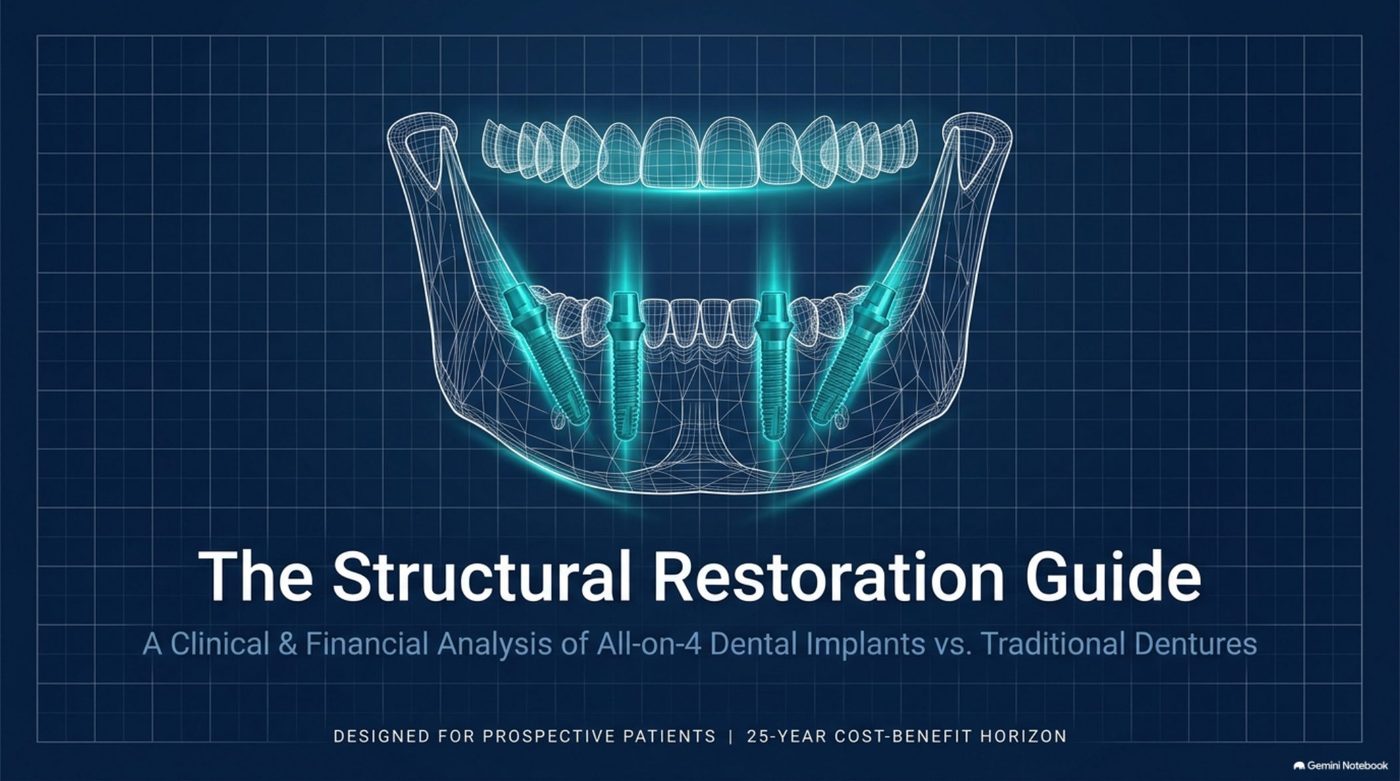
If this analysis produces a decision, the decision should carry numbers: the replacement cycles you are contracting for, the bite-force percentage you are willing to accept, and the bone trajectory you are choosing for the ridge under the arch. The deck's full 25-year cost-benefit analysis — upfront quote ranges, exclusions, and the cumulative cost curves — is in the companion guide, The Structural Restoration Guide (PDF). For budget framing around the same decision, see the cosmetic dentistry cost benchmarks and the smile makeover cost guide; the full calculator set lives at /tools/.
Frequently asked questions
Are All-on-4 implants always the better 25-year choice?
No. The matrix scores five criteria, and implant reconstruction wins all five — 90%+ bite force versus 20–30%, active bone stimulation versus accelerated loss, 25+ years versus 5–8, water-floss maintenance versus daily removal, and a 10–15 year crown cadence versus a 5–7 year full replacement. That is a structural argument, not a candidacy argument. A denture remains a legitimate choice when surgery is not appropriate, when the priority is the lowest possible upfront outlay, or when the appliance's easy adjustability matters more than the numbers it loses on.
Why stop the comparison at 25 years?
Because 25 years is the horizon the deck was built around, and it is long enough to expose the difference. Inside a single patient timeline of that length, dentures incur four to five full replacements and eight to twenty-five relines, while an All-on-4 structure incurs one or two crown refreshes and no post replacement. Shorten the window and the two options look closer than they are; lengthen it and the gap only widens.
Which single number should drive the decision?
Bone preservation, because it is the only criterion that changes the foundation everything else is built on. Once ridge width is gone, every subsequent denture is harder to fit and harder to keep seated. Bite strength is the number patients feel day to day, but bone is the number that decides whether the 25-year horizon is even available.