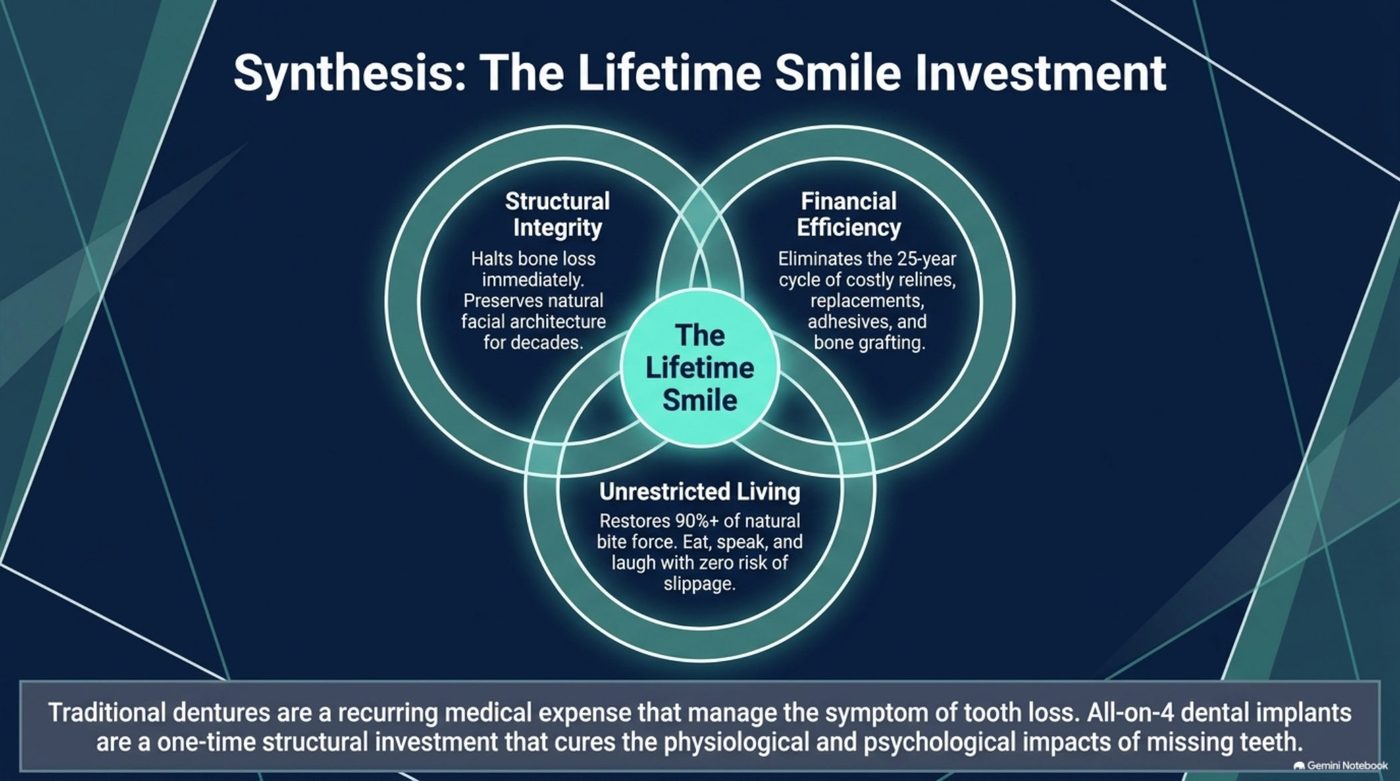
Every other decision in this series reduces to two ledgers, and a full-arch reconstruction is the only treatment that clears both. One ledger is structural: what happens to the jawbone and the facial architecture that depend on it. The other is financial: what the 25-year record of relines, replacements, adhesives, and repairs actually costs. Dentures lose on both. That is the entire argument, and it is arithmetic rather than opinion. This is written for people around Cedar Rapids, IA who are looking into smile center and want the honest version rather than a sales page.
Structural integrity: the bone is a use-it-or-lose-it asset
Alveolar bone stays dense because mechanical load passes through tooth roots into the jaw. Remove the roots and the load disappears, and the bone responds by resorbing. The first year is the steepest: a ridge typically loses roughly 25% of its width within 12 months of tooth loss, and vertical height loss in the first year commonly reaches a few millimeters. After that the process continues at a slower rate — on the order of a fraction of a percent per year — but it never reverses on its own.
The short version
- Alveolar bone resorbs roughly 25% of its ridge width within 12 months of tooth loss and continues slowly after, which flattens the lower face as the lip loses support.
- Dentures cost $1,500 to $5,000 per arch up front against $15,000 to $30,000 for All-on-4 (national mean about $24,000), and only implants put mechanical load back into bone.
- The denture ledger over 25 years includes 8 to 12 relines at $300 to $600, three to five replacement prosthetics at $2,000 to $4,000, and $2,500 to $7,500 in adhesives.
- Recurring denture costs commonly reach $2,400 to $2,800 a year once the appliance reaches middle age, versus an implant maintenance line of roughly $600 to $1,400 a year.
- Cumulative spending crosses over at about year 12 to 14, and needing bone grafting or a sinus lift at placement moves that crossover two to four years later rather than removing it.
- Implant-supported reconstructions restore more than 90% of natural bite force against roughly 20% to 25% for a conventional denture, with no slippage and no palatal coverage to disturb speech.
That is not a cosmetic footnote. Bone loss under a denture changes the lower third of the face: the lip loses support, the vertical dimension between nose and chin shortens, and the profile flattens over decades. An implant-supported reconstruction is the only restoration that puts load back into the bone. Osseointegration halts bone loss immediately at the loaded sites and preserves natural facial architecture for decades, because the implants transmit the same mechanical signal that kept the ridge dense in the first place. Dentures cannot do this — they sit on top of the ridge and press down on it.
The 25-year ledger
This is where the two options diverge permanently. A denture is a low upfront payment followed by a lifetime of recurring charges. An implant reconstruction is a high upfront payment followed by a comparatively small maintenance line. The table below models both over 25 years using 2025–2026 national benchmarks.
| Cost line | Conventional denture | All-on-4 implant reconstruction |
|---|---|---|
| Upfront | $1,500–$5,000 per arch | $15,000–$30,000 per arch (national mean baseline ≈ $24,000) |
| Relines | Every 2–3 years at $300–$600 → 8–12 relines = $2,400–$7,200 | None required; the prosthetic is fixed to the implants |
| Replacement prosthetics | Every 5–7 years at $2,000–$4,000 → 3–5 replacements = $6,000–$20,000 | Prosthetic wear-out typically much longer, sometimes never within 25 years |
| Adhesives / fixation | $100–$300 per year = $2,500–$7,500 | $0 |
| Repairs and adjustments | $200–$600 per incident, 1–2 per year in later years | Occasional screw or occlusal adjustment |
| Bone grafting after resorption | $1,000–$3,000 per site as the ridge shrinks | Avoided at the loaded sites; grafting may still be needed at placement |
| Professional maintenance | Exam and adjustment visits | Cleanings every 3–6 months at $150–$350 per visit ≈ $600–$1,400 per year |
The recurring denture lines — relines, replacements, adhesives, repairs, and later grafting — commonly total 2,400 to 2,800 dollars per year once the appliance reaches middle age. Against an implant maintenance line of roughly 600 to 1,400 dollars per year, cumulative spending crosses over at about year 12 to 14, and every year after that the gap widens in the implant's favor. If the implant case requires bone grafting or a sinus lift at placement, that crossover moves two to four years later; it does not vanish. The cost assumptions behind these figures are itemized in the cosmetic dentistry cost guide and in the Smile Architecture Blueprint (PDF).
Unrestricted living: the outcome measures
The structural and financial ledgers are the ones you can measure. The functional outcomes are the ones you live with daily:
- Bite force: implant-supported reconstructions restore more than 90% of natural bite force, against roughly 20% to 25% for a conventional denture. That difference decides whether you can eat steak, raw vegetables, or apples.
- Slippage: zero. A fixed prosthetic cannot lift, click, or drop mid-sentence, which removes the social arithmetic of choosing between speaking clearly and eating in public.
- Speech: no palatal coverage to interfere with articulation, so pronunciation stays stable without practice.
- Taste and comfort: no adhesive residue, no daily insertion and removal routine, no morning sore spots from a shifting appliance.
Where the two ledgers reinforce each other
Structural and financial integrity are the same argument viewed from different angles. Bone that is preserved is bone that does not need to be grafted later, so the structural choice is also the cost-avoidance choice. A denture that resorbs the ridge for 25 years eventually needs the grafting and implant work that earlier treatment would have made unnecessary — while the patient has also paid for eight to twelve relines and three to five replacement prosthetics along the way. The expensive path is not the one that costs the most today; it is the one that keeps charging for the rest of your life.
The decision framework
An implant reconstruction is the stronger case when several of the following are true: bone loss is already visible on a radiograph; the ridge is shrinking rather than stable; the denture moves during speech or eating; a reline or replacement has happened within the last three years; the lower face is showing height loss; or the patient is under 70 with 15 or more years of chewing ahead. A conventional denture remains a defensible choice when the medical picture rules out surgery, when bone volume is insufficient for implants without extensive grafting, or when the treatment must fit entirely within a defined short-term budget. In that last case the honest framing is that the recurring costs are deferred, not avoided — which is the point the 25-year ledger makes visible. The prospectus that lays out the full planning logic is here, and you can model your own numbers with the smile makeover cost guide.
FAQ About the Lifetime Smile Investment
Are All-on-4 implants really more affordable over 25 years?
On recurring-cost math, yes in most modeled cases. Denture relines, replacements, adhesives, repairs, and later grafting commonly reach 2,400 to 2,800 dollars per year, while implant maintenance runs roughly 600 to 1,400 dollars per year. Against an upfront of 15,000 to 30,000 dollars per arch, cumulative spending crosses at about year 12 to 14 and then diverges. Patients who need grafting at placement see the crossover move two to four years later.
What happens to my face if I stay in dentures?
The ridge loses roughly 25% of its width in the first year after tooth loss and continues to resorb slowly after that. As the bone shrinks, the lip loses support and the lower third of the face shortens. Implants return mechanical load to the bone, which halts resorption at the loaded sites and preserves the facial contour that depends on the ridge.
Do I still pay for anything after the implants are placed?
Yes, and it is the smallest line in the whole ledger: professional cleanings every 3 to 6 months at roughly 150 to 350 dollars per visit, plus occasional prosthetic adjustment. That maintenance is what protects the bone supporting the implants — skipping it is how a one-time structural investment turns into a recurring repair bill.