When two options are compared on price alone, the conversation ends with a single number. When they are compared on criteria, it ends with a decision you can defend. The restoration matrix does the second thing: it scores dentures and All-on-4 implants on five diagnostic criteria that determine what each treatment does across a 25-year horizon, and it does so in a form you can weight for your own case. Most people who read this are comparing cosmetic dental treatment options around Cedar Rapids, IA, so what follows sticks to the details that change in practice.
Why criteria beat quotes
A quotation measures one day in the process. It does not tell you what the restoration restores, what happens to the bone under it, how long the base structure is rated for, what you will do every night to maintain it, or how often it will be remade. Those five variables are what the matrix isolates, and they are the ones that separate an appliance from a structure. Below, each criterion is read on its own terms with the deck's figures intact.
The short version
- The matrix scores dentures and All-on-4 on five criteria — bite strength, jawbone preservation, base-structure lifespan, maintenance routine, and replacement frequency — and deliberately leaves pricing out.
- Dentures return 20 to 30 percent of natural bite force while All-on-4 returns 90 percent or more, because a fixed arch sends load down four posts into bone rather than onto gum tissue.
- Jawbone preservation is scored as a binary: dentures accelerate loss, with roughly 25% of ridge width gone in the first year, while implant posts act as artificial roots that stimulate bone.
- The base structure is rated 5 to 8 years for dentures versus 25-plus years for the titanium implant arch, so the 25-year horizon holds four to five denture bases but only one implant base.
- Dentures must come out nightly, soak, and go back with adhesives, while an All-on-4 arch stays fixed and is maintained by brushing and water-flossing around the abutments.
- Denture patients face eight to twenty-five relines plus four to five full replacements across 25 years, versus one to two crown refreshes every 10 to 15 years on the implant side.
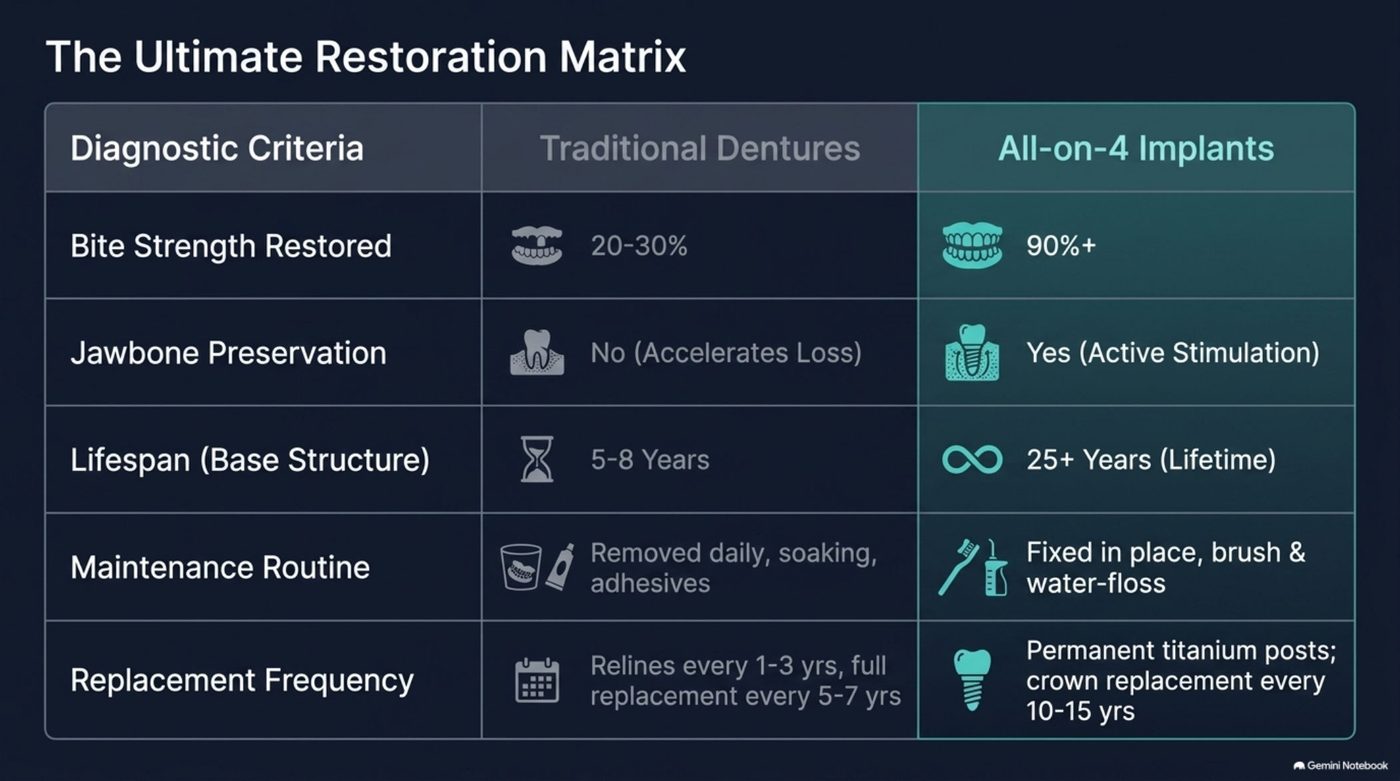
| Criterion | Traditional dentures | All-on-4 implants |
|---|---|---|
| Bite strength restored | 20–30% | 90%+ |
| Jawbone preservation | No (accelerates loss) | Yes (active stimulation) |
| Lifespan (base structure) | 5–8 years | 25+ years (lifetime) |
| Maintenance routine | Removed daily, soaking, adhesives | Fixed in place, brush and water-floss |
| Replacement frequency | Relines every 1–3 yrs; full replacement every 5–7 yrs | Permanent titanium posts; crown replacement every 10–15 yrs |
Criterion 1 — bite strength restored
Dentures return 20–30% of natural bite force. All-on-4 returns 90% or more. On its own that is a threefold to four-and-a-half-fold spread, but the more useful reading is where the force goes. A denture concentrates load where the saddle meets the ridge, over gum tissue. A fixed implant arch sends load down four posts into bone. That is why the bite-strength row and the bone row are not independent: the same mechanism that restores 90%+ of function is the one that keeps the ridge loaded and stable.
Criterion 2 — jawbone preservation
The matrix gives a binary answer here, not a percentage: dentures score no, accelerates loss; All-on-4 scores yes, active stimulation. Without root stimulation the jawbone immediately begins to shrink, and roughly 25% of ridge width is lost in the first year alone. A denture sits superficially on the gums, adding pressure where load is needed. Implant posts act as artificial roots, stimulating the bone and preserving architectural integrity. If you weight any single row of this matrix most heavily, this is the defensible one, because it is the only row that changes the foundation every other row depends on.
Criterion 3 — lifespan of the base structure
Dentures: 5–8 years. All-on-4: 25+ years, with the titanium posts treated as a lifetime component. Read against the 25-year horizon the deck uses, that is four to five denture base structures versus one implant base structure. This row is where the word investment earns its place — not as marketing language, but as the arithmetic of how many times the same item is purchased inside one timeline.
Criterion 4 — maintenance routine
The matrix draws the daily difference sharply. Dentures come out, soak, and go back in with adhesives. An All-on-4 arch stays fixed in place and is maintained by brushing and water-flossing around the abutments. The trade is real in both directions. The denture's routine is unglamorous but easy to inspect and easy to repair. The implant's routine takes seconds and removes an entire category of removal drama — no soaking, no adhesive, no risk of the arch moving while you speak — but it is non-negotiable, because hygiene around the posts is what protects the bone the posts depend on.
Criterion 5 — replacement frequency
Dentures carry two clocks: relines every 1–3 years and a full replacement every 5–7 years. All-on-4 carries one: crown replacement on the prosthetic every 10–15 years, with the permanent titanium posts not scheduled for replacement. Across 25 years that is eight to twenty-five relines plus four to five replacements on one side, and one to two crown refreshes on the other. This is the row that determines how many times you re-enter the treatment chair, and it is usually the row patients have never been shown.
How to weight the matrix for your own case
No matrix decides for you, but a weighted one comes close. If your priority is the lowest possible outlay in month one and the appliance is a bridge to a later decision, weight replacement frequency and lifespan down and the denture reads better. If your priority is keeping the bone you have, restoring 90%+ of chewing function, and not repurchasing the same arch four or five times over 25 years, weight jawbone preservation and lifespan up and the implant side wins every row. The honest discipline is to assign your weights before you see the quote, not after.
Reading the matrix alongside the rest of the plan
The matrix covers structure and function. Cost, financing, and phasing are addressed separately — the deck's companion PDF, The Structural Restoration Guide, carries the full 25-year cost-benefit analysis, while the cost benchmarks and the smile makeover cost guide cover upfront numbers. If you are choosing between material systems on top of the arch, or sizing a veneer case instead, the veneer cost calculator and the tools hub are the fastest way to compare them.
Frequently asked questions
Which row of the matrix matters most?
Jawbone preservation, because it is the only row that alters the foundation. Bite strength, lifespan, maintenance, and replacement frequency all describe a restoration sitting on bone; if the ridge is receding at roughly 25% of width in the first year, every other score is being measured against a moving surface.
Is the matrix a cost comparison?
No. It compares five diagnostic criteria — bite strength, bone preservation, base-structure lifespan, maintenance routine, and replacement frequency — and deliberately leaves pricing out of the frame. The value of separating them is that it shows why a lower upfront quote can still be the more expensive structure over 25 years once replacement cycles are counted.
Can both options appear in one treatment plan?
They can, and often do as sequence rather than as alternatives. The matrix is most useful as a filter for the endpoint you are aiming at, and then as a checklist for what the endpoint must satisfy.